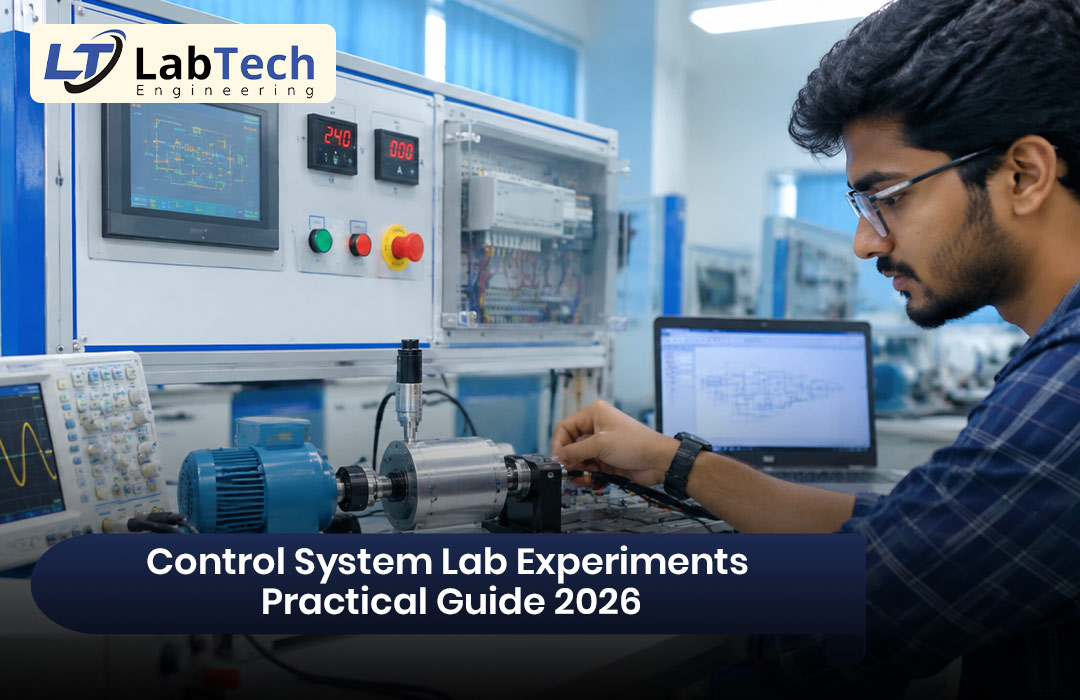
Control system lab experiments help students turn theory into real practice. In class, you learn transfer functions, poles, and stability. In the lab, you see how a motor, a heater, or a pendulum actually reacts to a controller. This guide explains the most common experiments, the equipment you need, and how to prepare. It is written for EEE, EE, and Mechatronics students and for institutions in Bangladesh.
What Are Control System Lab Experiments?
Control system lab experiments are practical tasks in which students build, test, and tune a system that controls itself using feedback. The system can be a DC motor, a temperature chamber, or a servo position setup.
Most experiments follow the same path:
- Model the system.
- Apply an input.
- Measure the output.
- Improve the response with a controller.
This is why a control system lab is one of the most useful labs in an engineering degree. It also teaches automation, robotics, and industrial process control.
Why Are These Experiments Important?
Theory alone cannot show noise, delay, friction, or real sensor error. Lab work does.
- Link theory to practice: You see poles, damping, and gain change a real output.
- Build industry skills: Factories in Bangladesh use PID controllers, PLCs, and drives every day.
- Improve problem solving: You learn to tune, test, and fix a system.
- Prepare for projects: Final-year projects in automation start from these basics.
List of Common Control System Lab Experiments
1. Time Response of First and Second Order Systems
Aim: To study how a system reacts to a step input.
Students measure rise time, peak time, settling time, and overshoot. You will see clearly how damping changes the response.
2. Block Diagram Reduction and Modeling
Aim: To simplify a complex system and find its transfer function.
This experiment is often done with a linear system simulator or with MATLAB/Simulink. It builds the base for every later experiment.
3. DC Motor Speed Control
Aim: To control motor speed using feedback.
Students compare open-loop and closed-loop control. They learn that feedback keeps the speed steady even when the load changes.
4. DC Servo Position Control
Aim: To control the angle or position of a motor shaft.
This experiment shows how gain affects accuracy and speed. It also introduces steady-state error.
5. PID Controller Tuning
Aim: To understand proportional, integral, and derivative action.
Students tune a PID controller and watch how each term changes the output. The Ziegler-Nichols method is a popular tuning rule used in many labs. To see the training side of this topic, read our guide on the PLC trainer kit.
6. Temperature Control System
Aim: To keep a heater or oven at a set temperature.
This is a classic process control experiment. It teaches slow system behavior and time delay, which are common in industry.
7. Stability Analysis: Root Locus and Bode Plot
Aim: To check whether a system stays stable when gain changes.
Students use root locus and frequency response methods. These are usually done in simulation, then checked on hardware.
8. Lag, Lead, and Lag-Lead Compensators
Aim: To improve system performance with a compensator network.
Students see how a compensator changes phase margin and response speed.
9. Synchro and Potentiometer Error Detector
Aim: To study how an error signal is created.
This experiment shows how position difference becomes a control signal.
10. Stepper Motor and Position Control
Aim: To study step angle and motion control.
This links control theory with mechatronics and robotics.
11. PLC-Based Control
Aim: To control a lift, a conveyor, or a pick-and-place model with ladder logic.
This is the bridge from classroom control to industrial automation.
Equipment Needed for a Control System Lab
A well-planned lab needs both hardware and software. Common items include:
- Linear system simulator and DC motor trainer
- DC servo position control trainer
- Temperature control system trainer
- PID controller trainer and PLC trainer
- Synchro and potentiometer error detector kit
- Stepper motor trainer
- Digital oscilloscope, power supply, and multimeters
- MATLAB/Simulink or similar simulation software
A good digital oscilloscope is a must for viewing step responses. Learn the differences in our blog on the types of oscilloscope. For motor-based trainers, our guide on electrical machine lab equipment is also helpful. If you want to see the complete range, visit the Control System Lab category.
Simulation vs Hardware Experiments
Both methods are useful, and the best labs use both.
| Point | Simulation | Hardware |
| Cost | Low | Higher |
| Speed | Very fast | Slower |
| Real effects | Not shown | Noise, friction, delay |
| Best use | Design and testing | Real validation |
Start with simulation to save time. Then confirm the result on real hardware. This is how engineers work in industry.
How to Prepare for a Control System Lab
- Read the theory first. Know the aim before you enter the lab.
- Study the circuit or block diagram. Understand each part.
- Check connections twice. Wrong wiring can damage the trainer.
- Record data carefully. Write the input, output, and time.
- Plot graphs neatly. Label each axis with units.
- Write a clear conclusion. Explain what the result shows.
Safety Tips
- Switch off the supply before changing any connection.
- Do not touch the heater or motor during operation.
- Use the correct fuse and power rating.
- Keep your hands away from rotating shafts.
- Report any fault to your instructor immediately.
Tips for Institutions Planning a Control System Lab in Bangladesh
Setting up a lab needs careful planning. Keep these points in mind:
- Match the syllabus. Choose trainers that cover your course experiments.
- Check build quality. Strong trainers last longer in daily student use.
- Ask for a manual. A good experiment manual saves teaching time.
- Plan after-sales support. Installation, training, and service matter.
- Compare options. Our guide on how to choose lab equipment in Bangladesh can help you decide.
For a bigger picture, read about university laboratory equipment in Bangladesh and power and automation lab equipment.
Frequently Asked Questions
What are the main control system lab experiments?
The main experiments are time response analysis, DC motor speed control, servo position control, PID tuning, temperature control, stability analysis, and compensator design.
Which software is used in a control system lab?
MATLAB and Simulink are the most common tools. Many labs also use LabVIEW.
What is the difference between open-loop and closed-loop control?
An open-loop system has no feedback. A closed-loop system measures the output and corrects errors automatically.
Why is PID control so popular?
PID control is simple, reliable, and works well for many systems, such as motors, heaters, and flow systems.
Where can I buy control system lab equipment in Bangladesh?
You can buy from trusted local suppliers such as LabTech Engineering, which supplies complete lab setups for institutions across the country.
About LabTech Engineering
LabTech Engineering is a leading provider of Electrical Machine Lab Equipment and advanced engineering laboratory solutions in Bangladesh. The company supports universities, polytechnic institutes, vocational training centers, research laboratories, and industrial training facilities with high-quality, innovative, and reliable equipment. LabTech delivers complete laboratory setup solutions for engineering and technical education.
LabTech Engineering is an Electrical and Electronics based research and development company. It is dedicated to improving technical education through modern laboratory solutions. With wide industry experience, it provides modern equipment, installation support, training services, and after-sales assistance, so every client gets maximum educational value.
You can learn more about the company on the About Us page and read its goals on the Mission and Vision page. See the institutions that trust the team on the Clients page. Browse all equipment in the Shop or the LabTech Shop.
Conclusion
Control system lab experiments build the skills that modern engineering needs. From time response to PID tuning, each experiment teaches you how to design a stable and accurate system. With the right trainers, clear manuals, and good safety habits, students learn faster and perform better.
Planning a new lab or upgrading an old one? Talk to the expert team at LabTech Engineering through the Contact Us page for the right equipment for your course and budget.