Concrete is the base of almost every building, bridge, and road in Bangladesh. But strong concrete does not happen by chance. Engineers must test it before, during, and after construction. This is why concrete testing equipment is a must-have for every civil engineering lab.
This guide explains the main types of concrete testing equipment, how each one works, and how to choose the right set for your lab in Bangladesh.
What Is Concrete Testing Equipment?
Concrete testing equipment is a group of machines, tools, and moulds. They measure the strength, workability, and quality of fresh and hardened concrete. Students use them to learn. Engineers use them to check that a mix meets the design needs.
Good testing reduces risk. It helps stop weak concrete from reaching the site. It also protects money, time, and lives.
Why Concrete Testing Matters in Bangladesh
Bangladesh has a hot and humid climate, soft soil, and a high water table. Rivers and coastal areas add more stress. Because of this, concrete here must be strong and durable.
Regular testing helps you to:
- Confirm that the concrete mix design is correct
- Check compressive strength at 7 and 28 days
- Find defects in old structures
- Meet university, polytechnic, and project requirements
- Train students with real material testing practice
Types of Concrete Testing Equipment
Concrete tests fall into two groups: fresh concrete tests and hardened concrete tests. Each group needs its own tools.
1. Fresh Concrete Testing Equipment
Fresh concrete tests are done right after mixing. They show how easy the mix is to place and compact.
- Slump cone set: This is the most common tool. It includes a metal cone, a base plate, and a tamping rod. It measures workability of concrete.
- Compaction factor apparatus: This checks workability for low-slump mixes.
- Flow table: This tests how well a mix spreads.
- Air content meter: This measures trapped air in the mix.
- Concrete thermometer: This records the temperature of fresh concrete.
2. Hardened Concrete Testing Equipment
These tools test the concrete after it sets and cures.
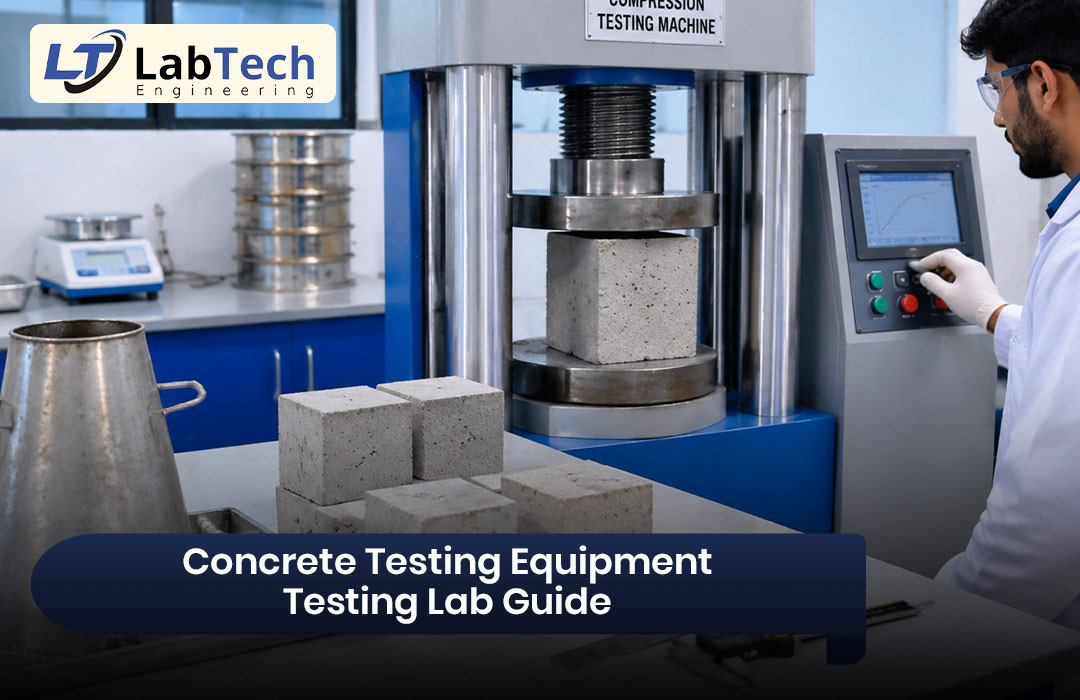
- Compression testing machine (CTM): This is the heart of the lab. It crushes cubes or cylinders to find the compressive strength of concrete.
- Cube moulds: Standard size is 150 mm. They make test cubes.
- Cylinder moulds: The common size is 150 mm × 300 mm.
- Beam moulds: These make beams for flexural strength tests.
- Curing tank: This keeps specimens in water at a steady temperature.
- Capping set: This levels the ends of cylinders before testing.
3. Non-Destructive Testing (NDT) Equipment
NDT tools test concrete without breaking it. They are very useful for old buildings.
- Rebound hammer (Schmidt hammer): It gives a quick estimate of surface hardness.
- Ultrasonic pulse velocity (UPV) tester: It checks the quality and finds cracks inside concrete.
- Rebar locator (cover meter): It finds steel bars and measures cover depth.
- Core cutting machine: It takes core samples from existing structures.
4. Aggregate and Cement Testing Tools
Concrete quality starts with its raw materials. A full lab also needs:
- Sieve shaker and sieves for aggregate grading
- Los Angeles abrasion machine for aggregate toughness
- Vicat apparatus for cement setting time
- Specific gravity and bulk density sets
For more on this topic, read our guide on material testing laboratory equipment and our post on soil testing lab equipment.
Common Concrete Tests and Their Purpose
| Test | Equipment Used | What It Shows |
| Slump test | Slump cone set | Workability of fresh concrete |
| Compressive strength test | Compression testing machine | Load-bearing strength |
| Flexural strength test | Beam mould and loading frame | Bending strength |
| Rebound hammer test | Rebound hammer | Surface hardness |
| UPV test | Ultrasonic tester | Internal quality and cracks |
| Cover meter test | Rebar locator | Bar position and cover |
How to Choose the Right Concrete Testing Equipment
Buying lab equipment is a big decision. Keep these points in mind.
1. Follow the standards. Check that the equipment meets ASTM or BS EN standards. These are the most used standards for concrete tests.
2. Pick the right capacity. A compression machine of 2000 kN is common for cube testing. Choose a size that fits your highest test load.
3. Check accuracy and calibration. Good equipment gives repeatable results. Ask for a calibration certificate.
4. Think about your lab size. A small polytechnic lab needs a basic set. A research lab needs advanced NDT tools.
5. Ask about after-sales support. Installation, training, and spare parts are very important. Without them, even good machines sit idle.
You can learn more in our post on how to choose lab equipment in Bangladesh.
Tips to Keep Your Equipment Accurate
- Clean moulds after every use and oil them lightly
- Calibrate the compression machine once a year
- Store rebound hammers in a dry, safe case
- Keep the curing tank at a steady temperature
- Train students and staff before they use any machine
- Keep a simple log of every test and every repair
Concrete Testing in a Complete Civil Lab
Concrete testing is only one part of a civil lab. A modern lab also includes soil, survey, and road testing. You can explore related topics like highway engineering lab equipment, structural mechanics lab equipment, and types of survey instruments.
For a wider view, see our guide on university laboratory equipment in Bangladesh.
Frequently Asked Questions
What is the most important concrete testing equipment?
The compression testing machine is the most important. It measures the strength that decides if concrete is safe to use.
How many days does concrete need before strength testing?
Most labs test at 7 days and 28 days. The 28-day result is the main design check.
Can concrete be tested without breaking it?
Yes. A rebound hammer and an ultrasonic pulse velocity tester can check concrete without damage.
Who needs concrete testing equipment in Bangladesh?
Universities, polytechnic institutes, construction companies, and quality control labs all need it.
Why LabTech Engineering Is a Trusted Partner
LabTech Engineering is a leading provider of laboratory equipment and engineering lab solutions in Bangladesh. We are an Electrical and Electronics based research and development company. Our goal is to improve technical education through modern, reliable lab setups. You can learn more about us and read our mission and vision.
We support universities, polytechnic institutes, vocational training centers, research laboratories, and industrial training facilities across the country. Our team provides complete lab setup, installation support, training, and after-sales help. See the institutions we serve on our clients page.
Explore our full product range, visit the LabTech shop, or browse our civil engineering lab equipment category. For a quote or advice, contact us today.