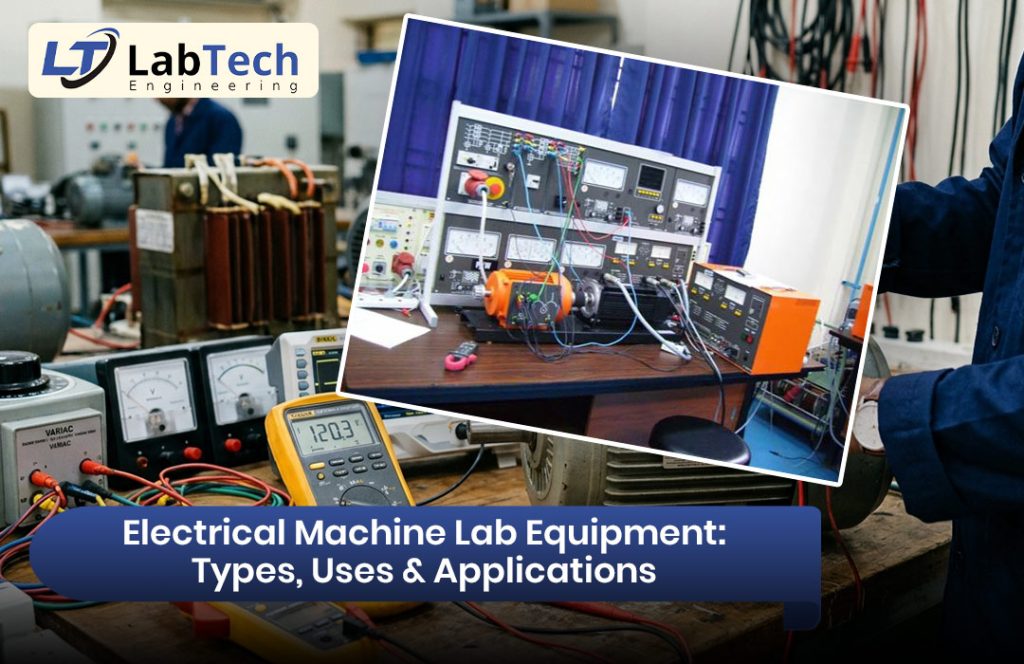
Electrical machines are an essential part of modern power systems, industrial equipment, manufacturing processes, and electrical engineering. To understand how motors, generators, transformers, and other electrical machines work, students and engineers need practical laboratory experience. This is where Electrical Machine Lab Equipment plays an important role.
A well-equipped electrical machine laboratory allows students to perform practical experiments, understand machine characteristics, analyze performance, and develop troubleshooting skills. Universities, engineering colleges, polytechnic institutes, technical training centers, and research organizations use electrical machine laboratory equipment to provide hands-on learning.
This guide explains the major types, uses, applications, and important factors to consider when selecting equipment for an electrical machine laboratory.
What Is Electrical Machine Lab Equipment?
Electrical Machine Lab Equipment refers to specialized machines, trainers, testing systems, measurement instruments, and accessories used to study the operation and performance of electrical machines.
These systems are designed to help learners understand the practical aspects of electrical engineering. Depending on the laboratory requirements, equipment can include DC machines, AC motors, synchronous machines, transformers, motor-generator sets, control panels, load banks, measuring instruments, and machine testing benches.
By using laboratory equipment, students can observe how electrical machines respond to different loads, speeds, voltages, and operating conditions.
Importance of Electrical Machine Laboratory Equipment
Theoretical knowledge is an important part of electrical engineering, but practical training helps students understand how electrical machines operate in real-world situations.
Electrical machine lab equipment helps students:
- Understand the working principles of electrical machines
- Perform practical machine tests
- Measure voltage, current, speed, torque, and power
- Analyze machine performance
- Study efficiency and losses
- Understand motor starting and speed control
- Develop electrical troubleshooting skills
- Gain practical experience with industrial equipment
Practical laboratory sessions also allow students to compare theoretical calculations with actual measurements. This helps them identify measurement errors, machine losses, and differences between ideal and practical operating conditions.
Types of Electrical Machine Lab Equipment
There are several types of equipment used in an electrical machine laboratory. The selection depends on the courses, experiments, laboratory size, and training requirements.
1. DC Motor and Generator Equipment
DC machines are commonly used for teaching the fundamental principles of electrical machines. A laboratory may include separately excited DC motors, shunt motors, series motors, compound motors, and DC generators.
Students can use these machines to study:
- Speed and torque characteristics
- Load characteristics
- Voltage regulation
- Efficiency
- Starting methods
- Speed control
- Generator characteristics
DC machine trainers are particularly useful for understanding the relationship between electrical input, mechanical output, speed, and load.
2. AC Induction Motor Equipment
AC induction motors are widely used in industrial applications, making them an important part of electrical machine laboratory training.
Common laboratory equipment includes single-phase and three-phase induction motors. Students can perform experiments related to starting current, speed, torque, slip, efficiency, and power factor.
Three-phase induction motor trainers can also be used to demonstrate different starting methods, including direct-on-line and star-delta starting.
Understanding induction motors is important for students who want to work in manufacturing, industrial automation, power systems, and electrical maintenance.
3. Synchronous Machine Equipment
Synchronous machines are another important category of Electrical Machine Lab Equipment. Synchronous motors and generators help students understand the principles of synchronous operation, excitation, power factor control, and voltage regulation.
Laboratory experiments may include:
- Open-circuit characteristics
- Short-circuit characteristics
- Voltage regulation
- Synchronization
- Power factor control
- Load characteristics
These experiments provide practical knowledge of machines commonly associated with power generation and industrial applications.
4. Transformer Laboratory Equipment
Although transformers do not convert electrical energy into mechanical energy like motors and generators, they are fundamental electrical machines used throughout power systems.
Transformer laboratory equipment can be used to perform open-circuit and short-circuit tests and study efficiency, losses, voltage regulation, polarity, and transformer connections.
Students can learn how transformers are used to increase or decrease voltage and how transformer performance changes under different loading conditions.
5. Motor-Generator Sets
Motor-generator sets combine a motor and generator to demonstrate electromechanical energy conversion.
These systems are useful for understanding how mechanical energy can be converted into electrical energy and how electrical energy can drive mechanical loads.
Motor-generator sets can be used for experiments involving load testing, speed control, generator characteristics, and energy conversion.
Electrical Machine Testing Equipment
Testing is an important part of electrical machine education. Proper testing equipment allows students to collect accurate data and evaluate machine performance.
Common testing instruments include:
- Digital multimeters
- Ammeter and voltmeter
- Wattmeters
- Power factor meters
- Tachometers
- Energy meters
- Torque measurement systems
- Load banks
- Oscilloscopes
- Power analyzers
These instruments allow students to measure important electrical and mechanical parameters during laboratory experiments.
For example, a tachometer can be used to measure motor speed, while a wattmeter can help determine electrical power consumption.
Applications of Electrical Machine Lab Equipment
Electrical machine laboratory equipment is used in several educational, research, and professional environments.
Engineering Education
Universities and engineering colleges use laboratory equipment to teach electrical machine theory through practical experiments. Students can directly observe machine behavior instead of depending only on diagrams and mathematical calculations.
Technical Training
Polytechnic institutes and technical training centers use electrical machine trainers to develop practical skills in motor operation, testing, wiring, control, and maintenance.
Research and Development
Research laboratories can use advanced machine testing systems to study motor efficiency, new control techniques, energy-saving technologies, and machine performance.
Industrial Training
Industries can also use laboratory-style training systems to train technicians and engineers on motor control, machine testing, troubleshooting, and maintenance procedures.
Product Testing
Specialized testing equipment can be used to evaluate machine performance under different loads and operating conditions.
Benefits of Using Modern Electrical Machine Lab Equipment
Modern laboratory equipment offers several advantages compared with basic or outdated systems.
Better Practical Learning
Students can directly interact with machines and observe their operating characteristics, making complex concepts easier to understand.
Accurate Measurements
Digital measurement systems can provide clear and reliable readings of voltage, current, power, speed, and other parameters.
Improved Safety
Modern trainers often include protective features such as circuit breakers, overload protection, emergency stop controls, and enclosed connections.
Easy Data Collection
Some advanced systems support digital displays, computer interfaces, and data acquisition systems, making it easier to record and analyze experimental results.
Industry-Relevant Skills
Modern equipment exposes students to technologies and testing methods commonly used in industrial environments.
How to Choose Electrical Machine Lab Equipment
Selecting the right Electrical Machine Lab Equipment requires careful planning. Institutions should consider their curriculum, laboratory space, budget, student capacity, and practical training requirements.
Some important factors include:
Equipment Quality
Choose durable equipment that can handle frequent laboratory use. Good build quality can reduce maintenance requirements and extend equipment life.
Safety Features
Safety should always be a priority. Look for equipment with proper electrical protection, overload protection, emergency stop systems, and safe connection points.
Measurement Accuracy
Laboratory experiments depend on accurate measurements. Equipment should provide reliable readings and use suitable measurement instruments for the required experiments.
Modular Design
Modular laboratory trainers can be useful because different machines, control systems, and measurement modules can be combined according to experiment requirements.
Ease of Operation
Equipment with clear controls, digital displays, and user-friendly interfaces can make laboratory sessions easier for both students and instructors.
Technical Support
After-sales support, maintenance services, spare parts, calibration, and technical assistance are also important when purchasing laboratory equipment.
Maintenance of Electrical Machine Lab Equipment
Regular maintenance helps keep laboratory equipment safe and reliable. Machines should be inspected regularly for loose connections, damaged cables, abnormal noise, overheating, and other issues.
Measurement instruments should also be checked and calibrated according to manufacturer recommendations. Motors and generators should be kept clean, while moving components should receive appropriate maintenance.
Proper storage is equally important. Equipment should be protected from excessive dust, moisture, heat, and other environmental conditions that may affect performance.
Role of Electrical Machine Lab Equipment in Modern Engineering Education
The electrical industry is continuously evolving with developments in automation, energy efficiency, renewable energy, electric vehicles, and smart power systems. As a result, engineering laboratories also need to provide practical exposure to modern technologies.
Traditional electrical machines remain important, but laboratories can also integrate modern motor drives, variable frequency drives, digital measurement systems, power analyzers, and computer-based data acquisition systems.
Combining traditional machines with modern control and measurement technologies creates a more complete learning environment and helps students develop skills relevant to today’s engineering industry.
Conclusion
Electrical Machine Lab Equipment provides the practical foundation for understanding motors, generators, transformers, and other electrical systems. From DC machines and induction motors to synchronous machines, transformer trainers, testing instruments, and modern measurement systems, each type of equipment serves an important educational purpose.
A well-planned electrical machine laboratory helps students understand theoretical concepts, perform practical experiments, analyze machine performance, and develop valuable troubleshooting skills. When selecting laboratory equipment, institutions should focus on quality, safety, accuracy, durability, ease of use, and technical support.
For universities, engineering colleges, technical institutes, and training centers, investing in reliable Electrical Machine Lab Equipment can create a practical learning environment that prepares students and professionals for real-world electrical engineering applications.
FAQ
1. What is Electrical Machine Lab Equipment?
It includes motors, generators, transformers, trainers, and testing instruments used for practical electrical engineering education.
2. What equipment is used in an electrical machine lab?
Common equipment includes DC machines, induction motors, synchronous machines, transformers, and measuring instruments.
3. Why is electrical machine lab equipment important?
It helps students understand machine operation through practical experiments and testing.
4. What can students learn in an electrical machine lab?
Students can learn motor testing, speed control, efficiency, load characteristics, and electrical measurements.
5. How do I choose electrical machine lab equipment?
Consider safety, accuracy, durability, laboratory requirements, budget, and technical support.