Power and automation laboratories play an important role in engineering education, technical training, research, and industrial skill development. As electrical systems become more advanced, students and professionals need practical experience with motors, generators, control systems, automation devices, and power electronics. This is where Power and Automation Lab Equipment becomes essential.
A properly equipped laboratory allows learners to understand electrical principles through practical experiments rather than relying only on theory. From studying motor characteristics to programming automation systems, modern laboratory equipment helps students develop the technical skills required in electrical engineering, industrial automation, and power-related industries.
What Is Power and Automation Lab Equipment?
Power and Automation Lab Equipment refers to a wide range of electrical, electronic, control, and measurement instruments used for teaching and testing power systems and automation technologies.
These equipment can be used in engineering universities, polytechnic institutes, technical training centers, research laboratories, and industrial training facilities. Depending on the purpose of the laboratory, equipment may include electrical machines, motor control systems, PLC trainers, variable frequency drives, power electronics trainers, measurement instruments, and electrical protection systems.
The right combination of equipment helps create a practical learning environment where students can safely perform experiments and understand how industrial electrical systems operate.
Why Is Power and Automation Lab Equipment Important?
Modern electrical engineering requires both theoretical knowledge and practical skills. A student may understand the principles of motors, transformers, or control systems from textbooks, but practical laboratory work provides a much deeper understanding.
Power and automation laboratory equipment helps students:
- Understand the operation of electrical machines
- Perform practical motor and generator experiments
- Learn industrial automation concepts
- Study electrical control circuits
- Develop PLC programming skills
- Understand power electronics and drives
- Measure electrical parameters accurately
- Troubleshoot electrical and automation systems
- Gain experience with equipment used in industry
For educational institutions, investing in reliable equipment can also improve the quality of laboratory training and help students become more prepared for professional engineering careers.
Types of Power and Automation Lab Equipment
There are several categories of equipment commonly used in power and automation laboratories. The exact selection depends on the laboratory’s objectives, available space, budget, and level of training.
1. Electrical Machines
Electrical machine equipment is one of the most important parts of a power laboratory. It allows students to study how electrical energy is converted into mechanical energy and vice versa.
Common equipment includes:
- DC motors and generators
- AC induction motors
- Synchronous motors and generators
- Single-phase motors
- Three-phase motors
- Motor-generator sets
- Electrical machine test benches
Students can perform experiments related to speed control, torque characteristics, efficiency, load testing, and motor performance.
2. Transformer Training Equipment
Transformers are fundamental components of electrical power systems. Transformer laboratory equipment allows students to study voltage transformation, efficiency, regulation, losses, and different transformer connections.
Typical experiments may include open-circuit and short-circuit tests, transformer efficiency measurement, polarity testing, and voltage regulation studies.
Practical transformer training helps learners understand how electrical power is transmitted and distributed in real-world systems.
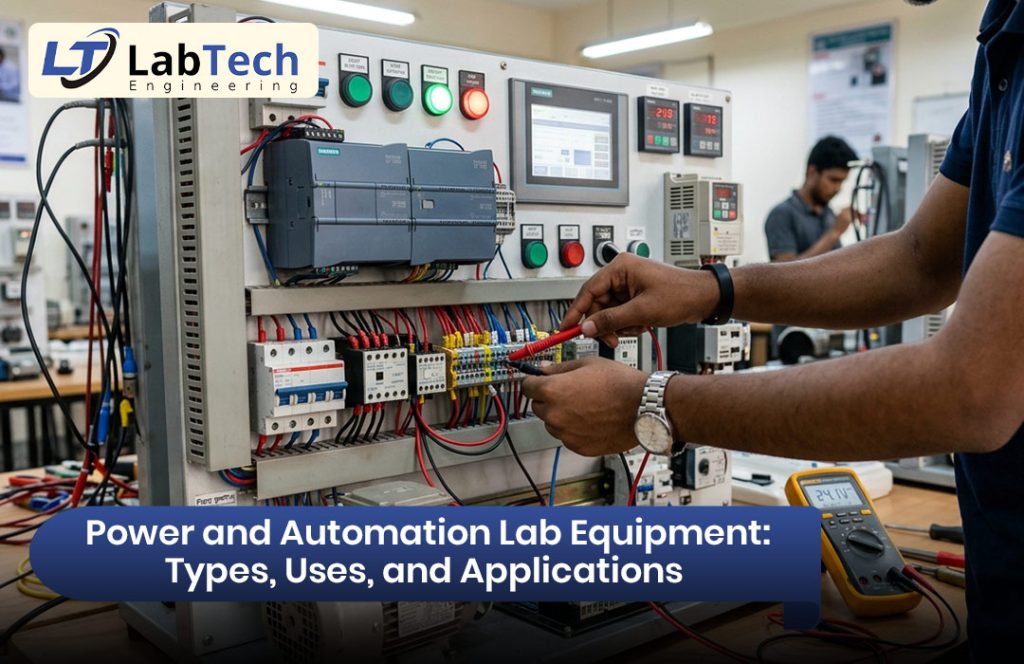
3. PLC and Automation Trainers
Programmable Logic Controllers, commonly known as PLCs, are widely used in industrial automation. PLC training equipment provides a practical way to learn how automated machines and processes are controlled.
A typical PLC trainer may include:
4. Motor Control Equipment
- PLC controller
- Digital and analog input/output modules
- Push buttons and switches
- Sensors
- Relays and contactors
- Indicator lamps
- Motor control interfaces
- HMI panels
- Communication interfaces
Students can create basic automation programs and gradually move toward more advanced industrial control applications.
Motor control is an important area of both power engineering and industrial automation. Motor control laboratory equipment helps students understand different methods of starting, stopping, reversing, and controlling electric motors.
Common training equipment includes direct-on-line starters, star-delta starters, contactor control systems, overload relays, motor protection devices, and control panels.
These practical exercises help students understand how motors are safely operated in industrial environments.
5. Variable Frequency Drives
Variable Frequency Drives, or VFDs, are commonly used to control the speed and performance of AC motors. VFD training equipment allows students to explore the relationship between motor speed, frequency, voltage, and load.
A VFD laboratory setup can be used to demonstrate:
- Motor speed control
- Frequency adjustment
- Acceleration and deceleration
- Motor protection
- Energy-saving applications
- Automated motor control
Understanding VFDs is particularly useful for students preparing for careers in industrial automation and manufacturing.
6. Power Electronics Training Equipment
Power electronics is another important part of modern electrical engineering. Power electronics laboratory equipment helps students understand how semiconductor devices are used to control and convert electrical power.
Training systems may include rectifiers, inverters, converters, thyristor circuits, IGBT-based systems, and controlled power supplies.
Students can learn how power electronic circuits are used in motor drives, renewable energy systems, industrial equipment, and power conversion applications.
7. Electrical Measurement and Testing Instruments
Accurate measurement is essential when working with electrical systems. Laboratory measurement equipment helps students measure voltage, current, resistance, power, frequency, and other electrical parameters.
Common instruments include:
- Digital multimeters
- Clamp meters
- Wattmeters
- Power analyzers
- Oscilloscopes
- Energy meters
- Insulation testers
- Electrical safety testers
These instruments also help students develop troubleshooting and testing skills.
Applications of Power and Automation Lab Equipment
The applications of Power and Automation Lab Equipment extend beyond classroom demonstrations. These systems can support education, research, product testing, technical training, and industrial skill development.
Engineering Education
Universities and engineering colleges use laboratory equipment to provide hands-on training in electrical machines, power systems, control engineering, and automation.
Industrial Training
Technical training institutes can use automation trainers, PLC systems, motor control panels, and VFDs to prepare learners for industrial jobs.
Research and Development
Researchers can use laboratory equipment to test new control methods, power conversion technologies, energy-efficient systems, and automation solutions.
Practical Skill Development
Hands-on experiments help students develop troubleshooting, measurement, programming, wiring, and system-analysis skills that are difficult to acquire through theoretical learning alone.
Industrial Automation
Automation training equipment can replicate common industrial processes and provide experience with PLCs, sensors, HMIs, motor drives, and control systems.
How to Choose the Right Power and Automation Lab Equipment
Selecting laboratory equipment requires careful planning. Institutions should first identify the courses, experiments, and training programs that the laboratory will support.
Important factors to consider include:
Training objectives: Equipment should match the subjects and practical experiments included in the curriculum.
Safety: Electrical training systems should include appropriate protection, emergency controls, and safe operating features.
Build quality: Laboratory equipment should be durable enough for repeated student use.
Measurement accuracy: Instruments should provide reliable readings for laboratory experiments.
Ease of operation: Equipment with clear controls and user-friendly interfaces can make practical training easier.
Expandability: Modular equipment can be useful because additional modules can be added as laboratory requirements grow.
After-sales support: Technical support, spare parts, maintenance, and training should also be considered when purchasing laboratory equipment.
Benefits of Modern Laboratory Equipment
Modern laboratory systems can significantly improve the quality of practical engineering education. Digital displays, modular trainers, data acquisition systems, and computer-based interfaces make experiments easier to monitor and analyze.
Some major benefits include:
- Better understanding of engineering concepts
- Faster and more organized experiments
- Improved measurement accuracy
- Practical exposure to industrial technologies
- Better troubleshooting skills
- Safer laboratory operation
- Improved student engagement
- Preparation for modern engineering careers
For institutions planning a new laboratory, combining basic electrical equipment with modern automation technologies can create a more complete learning environment.
Power and Automation Laboratory Setup
A successful laboratory does not necessarily require every available piece of equipment. The setup should be designed according to the institution’s training requirements.
A basic laboratory may start with electrical machine trainers, measurement instruments, transformer trainers, motor control panels, and basic PLC systems. More advanced laboratories can include VFDs, HMI systems, industrial communication modules, power electronics trainers, data acquisition systems, and renewable energy training equipment.
Proper laboratory layout is also important. Equipment should be positioned to provide sufficient working space, safe electrical connections, ventilation, and easy access for instructors and students.
Conclusion
Power and Automation Lab Equipment provides the practical foundation needed to teach modern electrical engineering and industrial automation. From electrical machines and transformers to PLC trainers, VFDs, power electronics systems, and measurement instruments, these tools help students connect theoretical concepts with real-world applications.
When selecting equipment, institutions should focus on safety, reliability, accuracy, training requirements, expandability, and after-sales technical support. A well-planned laboratory can improve practical education, support technical research, and prepare students for the changing demands of the electrical and automation industry.
For universities, technical institutes, and training centers, investing in the right Power and Automation Lab Equipment is an important step toward building a modern engineering laboratory that supports effective learning and professional skill development.
FAQs
1. What is Power and Automation Lab Equipment?
Equipment used for practical training in power systems, electrical machines, and industrial automation.
2. What equipment is used in a power lab?
Electrical machines, transformers, meters, motor trainers, and power electronics equipment.
3. What is a PLC trainer used for?
It helps students learn PLC programming and industrial automation.
4. Why are VFDs used in labs?
VFDs demonstrate motor speed and frequency control.
5. How do I choose lab equipment?
Consider safety, accuracy, durability, training needs, and budget.