An oscilloscope is one of the most useful tools in any electronics lab. It shows you an electrical signal as a graph, so you can see how voltage changes over time. But before you buy or use one, you need to know the types of oscilloscope and how they are different. Some are simple and low cost. Others can capture, store, and analyze very fast signals.
In this guide, we explain each type in easy words. We also compare the analog oscilloscope with the digital storage oscilloscope (DSO), so students, teachers, and lab managers in Bangladesh can choose the right one.
What Is an Oscilloscope?
An oscilloscope is a test instrument that draws a picture of an electrical signal on a screen. The horizontal line shows time. The vertical line shows voltage. With this picture, you can measure the following:
- Voltage level (amplitude)
- Frequency and time period
- Rise time and fall time
- Noise and distortion in a signal
- Phase difference between two signals
Oscilloscopes are used in EEE, ETE, CSE, and mechatronics labs. They are also used by technicians who repair TVs, power supplies, inverters, and industrial control boards.
Main Types of Oscilloscope
The two main groups are analog and digital. Digital oscilloscopes have several sub-types. Let us look at each one.
1. Analog Oscilloscope
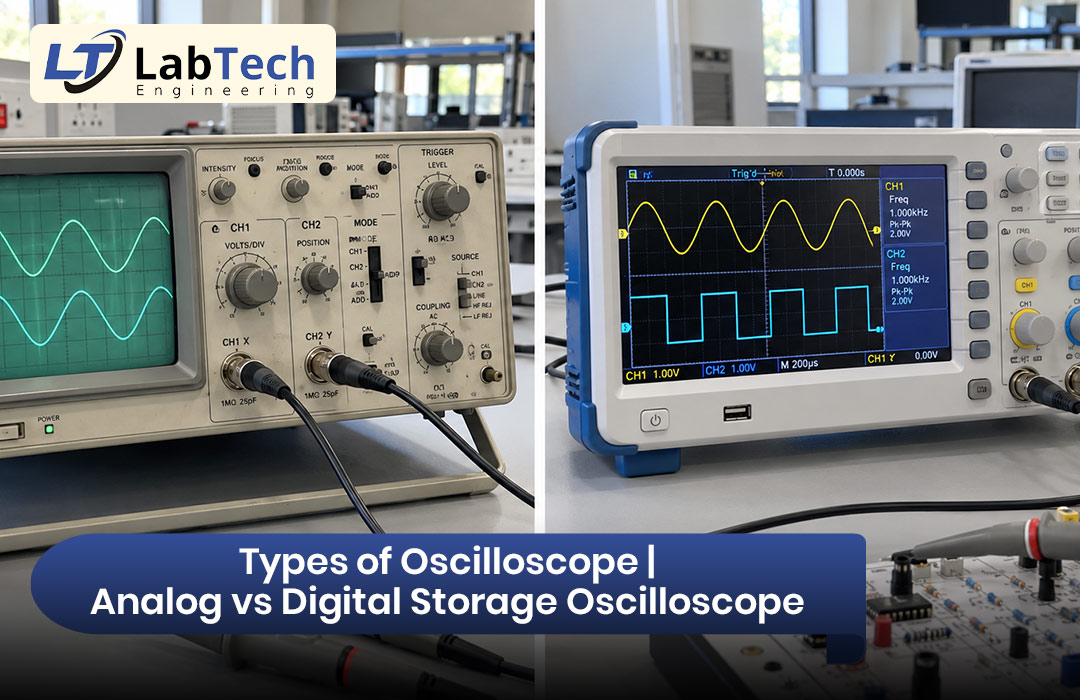
An analog oscilloscope shows the input signal directly on the screen. Older models use a cathode ray tube (CRT). An electron beam moves across the screen and draws the waveform in real time.
Advantages:
- Real-time display with no delay
- Simple to use and easy to learn
- Lower cost in many cases
- Good for teaching basic wave concepts
Limitations:
- Cannot store a waveform for later study
- Hard to capture a single, fast event
- Few automatic measurements
- Bulky size and heavier weight
Analog scopes are still found in many older university and polytechnic labs in Bangladesh.
2. Digital Storage Oscilloscope (DSO)
A digital storage oscilloscope uses an analog-to-digital converter (ADC). The ADC takes many samples of the input signal and saves them in memory. Then the scope draws the waveform on a screen, usually an LCD.
Advantages:
- Stores waveforms and screenshots
- Captures one-time events with advanced triggering
- Gives automatic measurements such as frequency, peak voltage, and RMS
- Offers math functions and FFT (frequency analysis)
- Thin, light, and easy to connect to a computer
Limitations:
- Usually costs more than a basic analog model
- A low sample rate can miss fast details
Today, the DSO is the most common choice for engineering labs because it is accurate, flexible, and easy to use.
3. Digital Phosphor Oscilloscope (DPO)
A digital phosphor oscilloscope is a type of digital scope that updates its display very fast. It also shows how often a signal appears by using brighter and darker colors. This works a bit like an analog scope. It helps you see rare glitches in a signal.
4. Mixed Signal Oscilloscope (MSO)
A mixed signal oscilloscope combines a digital oscilloscope with a logic analyzer. It has normal analog channels and extra digital channels. You can view an analog sensor signal and a digital data signal at the same time on one screen. This is very helpful for microcontroller and embedded system work.
5. Mixed Domain Oscilloscope (MDO)
A mixed domain oscilloscope adds a spectrum analyzer to the scope. It lets you view signals in both the time domain and the frequency domain. It is mainly used in RF and wireless communication work.
6. Sampling Oscilloscope
A sampling oscilloscope is made for very high-frequency signals that repeat again and again. It builds the waveform from samples taken over many cycles. It is used in advanced research and high-speed communication tests.
7. Handheld and Portable Oscilloscope
A handheld oscilloscope is small, runs on a battery, and often has a built-in multimeter. Field engineers and service technicians like it because they can carry it to a site.
8. PC-Based (USB) Oscilloscope
A USB oscilloscope has no big screen of its own. It connects to a laptop or computer, and software shows the waveform. It is small and low cost, which makes it popular for students and hobby work.
Analog vs Digital Storage Oscilloscope: Key Differences
- Display: Analog uses a CRT and shows the signal live. Digital uses an LCD and shows sampled data.
- Storage: Analog cannot store a waveform. A DSO can store many.
- Measurements: Analog needs manual reading from the screen grid. A DSO gives automatic readings.
- Single events: Analog struggles to catch them. A DSO can capture them with its trigger.
- Connectivity: Analog has none in most cases. A DSO often has USB or LAN ports.
- Size: Analog is heavy and large. A DSO is slim and light.
- Best for: Analog suits basic teaching. A DSO suits modern labs, design work, and repair.
Important Specifications to Check
When you compare oscilloscopes, look at these points:
- Bandwidth: This shows the highest frequency the scope can measure well. A common rule is to choose a bandwidth at least five times higher than the signal you want to measure.
- Sample rate: This is how many samples the scope takes each second. A higher rate shows more detail.
- Number of channels: Two channels are enough for most student labs. Four channels help with power and control work.
- Memory depth: More memory lets you record longer signals without losing detail.
- Triggering options: Good triggers help you catch the exact event you need.
- Display size and connectivity: A clear screen and USB or LAN ports make the work easier.
Which Oscilloscope Should You Choose?
- For school and basic college labs: A two-channel DSO with moderate bandwidth is a good start.
- For EEE and power labs: A DSO with enough channels and good triggering works well. See our guide on electrical machine lab equipment for related lab tools.
- For microcontroller and embedded labs: An MSO is very helpful.
- For RF and communication labs: Look at a high-bandwidth scope or an MDO.
- For field service: A handheld model is practical.
For more help, read our article on how to choose lab equipment in Bangladesh and our overview of EEE lab equipment in Bangladesh.
Common Uses of Oscilloscopes
- Testing power supplies, inverters, and converters
- Checking sensor and amplifier circuits
- Debugging microcontroller and digital circuits
- Studying AC waveforms in electrical machine experiments
- Repairing electronic boards in service centers
- Training students in labs and workshops
Oscilloscopes also support experiments in power and automation lab equipment setups.
Buy Oscilloscopes and Lab Equipment in Bangladesh
LabTech Engineering is a leading provider of Electrical Machine Lab Equipment and advanced engineering laboratory solutions in Bangladesh. We support universities, polytechnic institutes, vocational training centers, research laboratories, and industrial training facilities with high-quality, innovative, and reliable laboratory equipment. We deliver complete laboratory setup solutions for engineering and technical education institutions across the country.
LabTech Engineering is an Electrical and Electronics-based research and development company that works to improve technical education through modern laboratory solutions. With wide industry experience, we provide modern equipment, installation support, training services, and after-sales help, so that every client gets the most educational value.
You can see a digital storage oscilloscope in our range, such as the GW Instek GDS-1102B digital storage oscilloscope. To explore more, visit our products page or our online shop.
Want to know more about us? Read about LabTech Engineering and our mission and vision. You can also see the institutions we have worked with on our clients page. For more guides, visit the LabTech Engineering blog, or read about our role as an engineering lab equipment supplier in Bangladesh.
Frequently Asked Questions
What are the main types of oscilloscope?
The two main types are analog and digital. Digital oscilloscopes include DSO, DPO, MSO, MDO, sampling, handheld, and PC-based models.
What is the difference between analog and digital storage oscilloscope?
An analog scope shows the signal live on a CRT and cannot store it. A digital storage oscilloscope samples the signal, stores it in memory, and shows it on an LCD with automatic measurements.
Which oscilloscope is best for students?
A two-channel digital storage oscilloscope is a good choice for most student labs.
What does bandwidth mean in an oscilloscope?
Bandwidth is the highest signal frequency that the scope can measure with good accuracy.
Is a USB oscilloscope good enough for lab work?
It is fine for basic learning and low-cost projects. For regular lab use and training, a standalone DSO is usually more convenient.
Final Thoughts
There are many types of oscilloscope, but the choice is simple when you know your need. Use an analog scope for basic teaching, a digital storage oscilloscope for most modern labs, an MSO for embedded work, and an MDO for RF work. Always check bandwidth, sample rate, channels, and memory before you buy.
Need help setting up your lab? Contact LabTech Engineering today, and our team will guide you from selection to installation and support.