Digital logic design lab equipment is the set of trainers, components, tools, and instruments students use to build and test digital circuits. In this lab, students learn how logic gates, adders, flip-flops, counters, and memory work in real hardware. Theory in the classroom becomes clear when students wire a circuit and see an LED turn on.
In Bangladesh, a digital logic design lab is a core part of CSE, EEE, and ETE programs. It is also common in polytechnic institutes and technical training centers. A well-equipped lab helps students build strong basics before they move to microprocessors, embedded systems, and VLSI.
At LabTech Engineering, we supply engineering laboratory solutions to institutions across the country. This guide explains what a complete DLD lab needs, how each item is used, and how to choose the right setup.
Why a Good DLD Lab Setup Matters
A weak lab setup slows learning. Broken trainers, loose wires, and missing ICs waste class time. A strong digital logic lab setup gives you these benefits:
- Students finish experiments on time.
- Teachers can run more lab groups per week.
- Faulty circuits are easier to find and fix.
- Students gain hands-on skills that employers value.
Essential Digital Logic Design Lab Equipment List
1. Digital Logic Trainer Kit
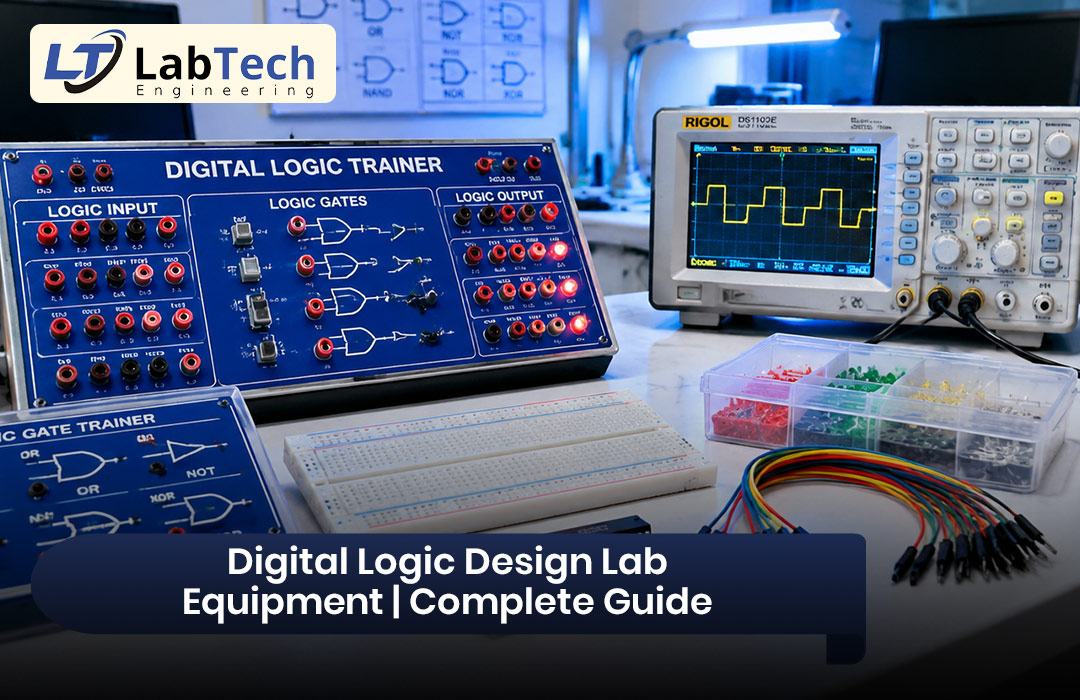
The digital logic trainer kit is the heart of the lab. It usually includes a built-in power supply, a breadboard area, logic switches, LED indicators, a clock generator, and sometimes seven-segment displays. Students can build many circuits on one board without extra tools.
A good trainer should have a stable 5V DC supply for TTL circuits. It should also have clean clock pulses and strong, protected input and output points. You can explore ready-made options in our DLD Lab category.
2. Breadboards and Jumper Wires
A breadboard lets students build circuits without soldering. They place ICs on it and join pins with jumper wires. Always keep extra breadboards and a full set of colored wires in stock, because these items wear out first.
3. Digital ICs (74 Series and CMOS)
Digital ICs are the building blocks of every experiment. A basic DLD lab should stock the following:
- Logic gates: 7400 (NAND), 7402 (NOR), 7404 (NOT), 7408 (AND), 7432 (OR), and 7486 (XOR)
- Combinational ICs: 7483 (4-bit adder), 74138 (decoder), 74151 (multiplexer), and 7447 (BCD to seven-segment decoder)
- Sequential ICs: 7474 (D flip-flop), 74112 (JK flip-flop), 7490 (decade counter), and 74194 (shift register)
You can find many of these parts in our IC component category.
4. Logic Probe and Digital IC Tester
A logic probe shows whether a point in a circuit is high, low, or pulsing. A digital IC tester checks whether an IC is working before students use it. Together, they save a lot of time during troubleshooting.
5. Digital Multimeter
A digital multimeter measures voltage, current, and resistance. Students use it to confirm supply voltage and to check continuity in wires.
6. Oscilloscope and Function Generator
An oscilloscope displays signal waveforms. It is very useful when students study clock signals, counters, and timing. A function generator provides square-wave clock input for sequential circuits. To learn more about scope options, read our guide on the types of oscilloscope.
7. DC Power Supply
A regulated DC power supply is needed when students build circuits outside the trainer. Choose a supply with an adjustable output and short-circuit protection.
8. LEDs, Switches, Resistors, and Seven-Segment Displays
These small parts show the result of each circuit. Students use LEDs to see logic output, DIP switches to give input, and seven-segment displays to show numbers. Stock extra resistors in common values, such as 330 ohm and 1 kilo-ohm.
9. Basic Hand Tools
A wire stripper, a pair of pliers, tweezers, and an IC extractor keep the lab running smoothly. They also protect IC pins from damage.
10. FPGA Boards and Simulation Software
Modern DLD courses also teach Verilog or VHDL. For this, labs add FPGA development boards and computers with simulation tools such as Logisim, Proteus, Multisim, Quartus, or Vivado. Students first test a design on the screen, then load it on the board.
Common Experiments Done with This Equipment
A complete DLD lab supports experiments like these:
- Verification of basic logic gates and truth tables
- Building gates from NAND and NOR gates
- Half adder and full adder circuits
- Multiplexers, decoders, and encoders
- Flip-flops, registers, and counters
- Seven-segment display driving
- Simple state machine design using FPGA
How to Choose the Right Digital Logic Lab Equipment
Before you buy, think about the following points.
Course needs. Match the equipment to your syllabus. A BTEB polytechnic lab may need simple trainers, while a university may need FPGA boards too.
Number of students. Plan one workstation for every two or three students. This keeps everyone active during the class.
Build quality. Choose trainers with strong boards, protected circuits, and clear labels.
Warranty and spare parts. ICs and wires will fail over time. Ask whether the supplier can provide parts quickly.
Installation and training. Good suppliers set up the lab and train your staff. Our how to choose lab equipment in Bangladesh guide explains more buying steps. You may also like our post on local vs imported lab equipment in Bangladesh.
Tips to Maintain Your DLD Lab
- Keep ICs in anti-static boxes.
- Switch off the power before changing any wire.
- Check trainer power supplies every semester.
- Replace bent or broken jumper wires early.
- Label every trainer and keep a simple repair log.
Small habits like these can extend equipment life by many years.
Frequently Asked Questions
What equipment is used in a digital logic design lab?
A DLD lab uses a digital logic trainer, breadboards, digital ICs, a logic probe, a multimeter, an oscilloscope, a function generator, a power supply, and basic hand tools. Many labs also use FPGA boards and simulation software.
What is a digital logic trainer?
A digital logic trainer is a board with a power supply, switches, LEDs, a clock, and a breadboard area. It lets students build and test digital circuits quickly and safely.
Which ICs are used in the digital logic lab?
The most common are 74 series ICs, such as 7400, 7408, 7432, 7404, 7486, 7474, and 7490. These cover gates, adders, flip-flops, and counters.
Can a polytechnic institute set up a DLD lab easily?
Yes. With a trainer kit, basic components, and a few instruments, a polytechnic institute can start a working lab. A trusted supplier can help with the full setup.
Why LabTech Engineering Is a Trusted Partner for Digital Logic Labs
LabTech Engineering is a leading provider of Electrical Machine Lab Equipment and advanced engineering laboratory solutions in Bangladesh. We support universities, polytechnic institutes, vocational training centers, research laboratories, and industrial training facilities with high-quality, reliable lab equipment. As an Electrical and Electronics based research and development company, we also offer installation support, training services, and after-sales assistance, so your lab delivers full educational value.
Learn more about us, read our mission and vision, or see the institutions we have served on our clients page. You can browse our full product range or visit the LabTech shop to see available items. If you plan a bigger project, our guide on university laboratory equipment in Bangladesh is a helpful next read, and our PLC trainer kit article shows where digital logic skills lead in industry.
Ready to build or upgrade your lab? Contact LabTech Engineering today for a quote and expert advice.