A clear physics lab equipment list is the first step to building a safe and useful practical lab. Without a proper list, many institutions buy the wrong items, miss important tools, or spend more than they need. This guide explains the physics lab equipment that schools and colleges in Bangladesh need, what each item is used for, and how to choose the right setup.
What Is a Physics Lab Equipment List?
A physics lab equipment list is a checklist of instruments, apparatus, and safety items used to perform physics experiments. It usually covers measurement, mechanics, heat, light, sound, electricity, magnetism, and modern physics. A good list matches the syllabus, the number of students, and the budget of the institution.
Basic Physics Lab Equipment for Measurement
Every school physics lab starts with measuring tools. Students use them in almost every experiment.
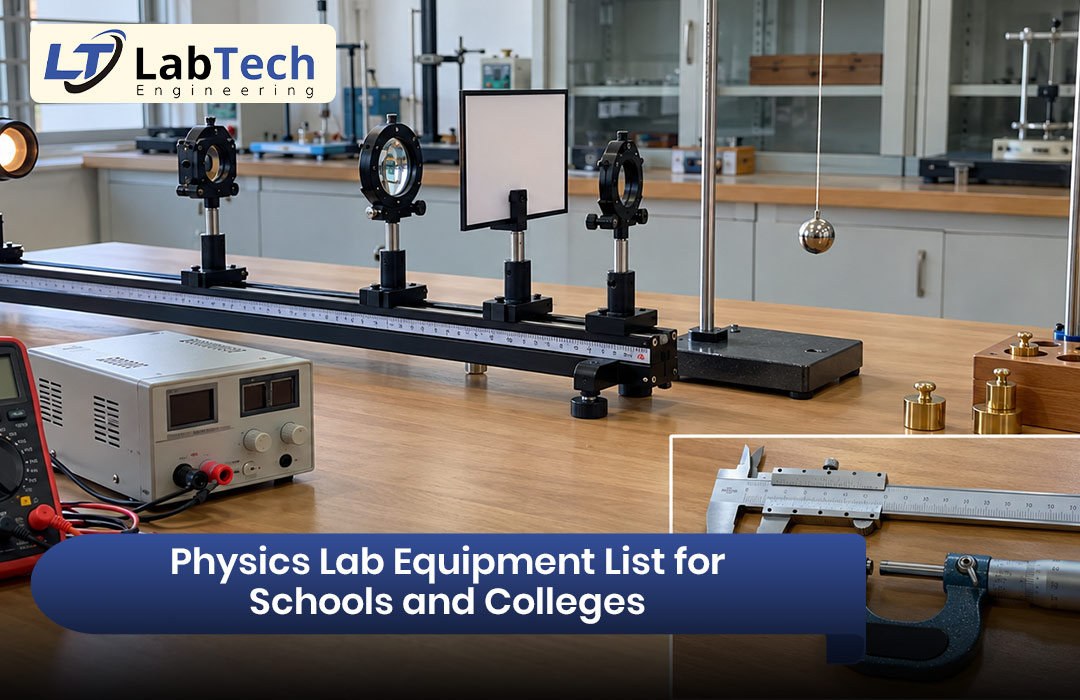
- Vernier caliper: measures the length, width, and inside or outside diameter of small objects.
- Screw gauge (micrometer): measures very small thickness, such as a wire or a thin sheet.
- Meter scale and measuring tape: measure length in simple experiments.
- Stopwatch: measures time, for example, the time period of a pendulum.
- Physical balance and weight box: measure mass accurately. Many labs now also use a digital balance.
- Spherometer: measures the curvature of lenses and mirrors. It is mostly used in college physics labs.
Mechanics Equipment
Mechanics experiments help students understand force, motion, and energy.
- Simple pendulum with stand and bob
- Inclined plane and friction apparatus
- Spring balance and spring sets for Hooke’s law
- Pulleys, clamps, and retort stands
- Trolleys or dynamic carts for Newton’s laws of motion
- Ballistic pendulum and air track for advanced college experiments
Heat and Thermodynamics Equipment
These tools help students study temperature, heat transfer, and gas laws.
- Thermometers
- Calorimeter and immersion heater for specific heat capacity
- Joule’s calorimeter
- Boyle’s law apparatus
- Heat transfer apparatus
If your institution also teaches engineering subjects, read our guide on thermodynamics lab equipment for more advanced heat experiments.
Light and Optics Equipment
Optics experiments need careful and stable setups.
- Convex and concave lenses
- Convex and concave mirrors
- Glass prism
- Optical bench with holders
- Spectrometer
- Diffraction grating
- Laser source (for example, a He-Ne laser in college labs)
- Newton’s rings setup
Sound and Wave Equipment
- Tuning forks
- Sonometer
- Resonance tube apparatus
- Signal or function generator
Electricity and Magnetism Equipment
This section is very important for both HSC-level and university-level practicals.
- Voltmeter, ammeter, and galvanometer
- Digital multimeter
- Rheostat and resistance box
- DC power supply or battery eliminator
- Meter bridge, Wheatstone bridge, and potentiometer
- Resistors, capacitors, wires, and connectors
- Bar magnets, magnetic compass, and electromagnet
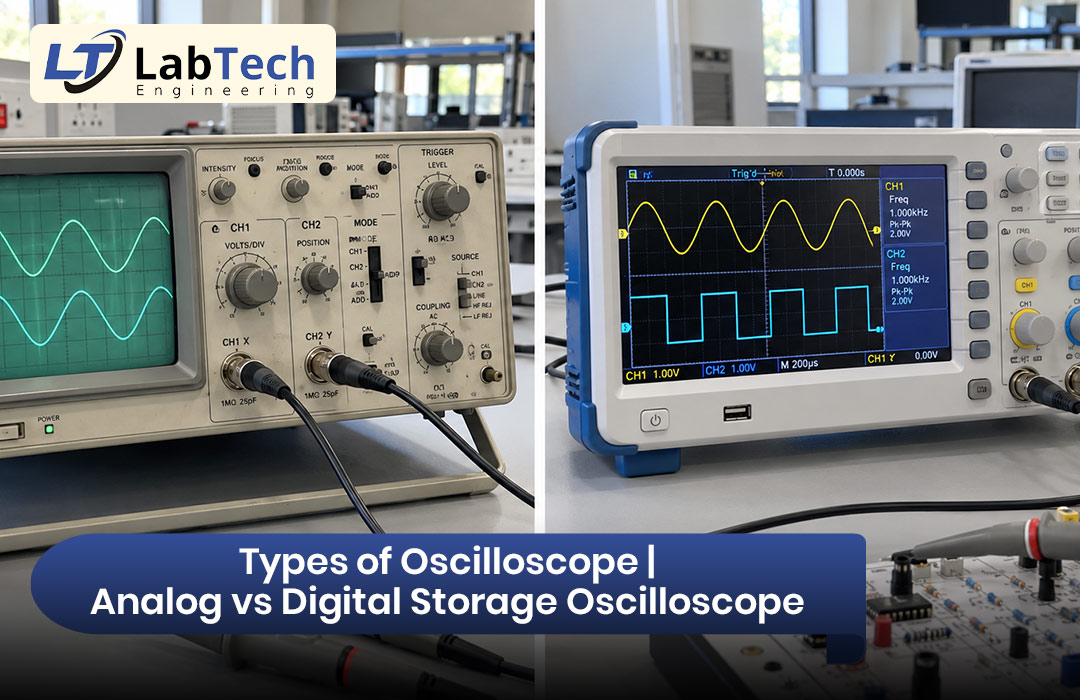
- Function generator and oscilloscope for waveform studies
An oscilloscope is a key instrument in a modern physics lab. To understand the difference between the two main kinds, read our blog on the types of oscilloscope.
Modern Physics Equipment for Colleges
Higher-level labs may include:
- Photoelectric effect setup
- Planck’s constant apparatus
- Franck-Hertz experiment setup
- Cathode ray tube
- Geiger-Muller counter
- Hall effect apparatus
These items are more costly and need trained staff, so plan them after the basic lab is complete.
Safety Equipment Every Physics Lab Needs
Safety items protect both students and equipment. Do not skip them.
- First aid kit
- Fire extinguisher and fire blanket
- Safety goggles
- Lab aprons
- Insulated tools and a proper circuit breaker for electrical work
School vs College Physics Lab: What Is the Difference?
School physics lab: Focus on basic and low-cost items. Examples include the vernier caliper, screw gauge, pendulum, spring balance, lenses, prism, simple circuit kits, and a multimeter.
College physics lab: Add more precise and advanced items. Examples include a spectrometer, optical bench, sonometer, potentiometer, Hall effect setup, oscilloscope, and modern physics apparatus.
How to Choose the Right Physics Lab Equipment
Follow these simple steps before you buy:
- Check the syllabus. Buy only what your practical classes need.
- Count your students. A common approach is one set for every two to four students, so everyone can take part.
- Check accuracy. Choose instruments with clear markings and proper calibration.
- Check the power rating. Equipment must work with Bangladesh’s 220 V, 50 Hz supply.
- Ask about service. Choose a supplier that offers installation, training, and after-sales support.
- Compare local and imported options. Our guide on local vs imported lab equipment in Bangladesh can help you decide.
For a full buying checklist, you can also read how to choose lab equipment in Bangladesh.
How to Take Care of Physics Lab Equipment
Bangladesh has a warm and humid climate, so good care matters.
- Keep instruments dry and covered when not in use.
- Store delicate items, such as lenses and prisms, in soft-lined boxes.
- Calibrate meters and balances regularly.
- Keep a record register for each item and check it every term.
- Replace worn wires and damaged parts quickly.
Where to Buy Physics Lab Equipment in Bangladesh
If you are planning a new lab or upgrading an old one, you can explore our physics lab equipment range. You can also browse our full product catalog or visit the LabTech shop.
LabTech Engineering is a leading provider of Electrical Machine Lab Equipment and advanced engineering laboratory solutions in Bangladesh. We support universities, polytechnic institutes, vocational training centers, research laboratories, and industrial training facilities with high-quality, innovative, and reliable laboratory equipment. We also deliver complete laboratory setup solutions for engineering and technical education institutions across the country.
LabTech Engineering is an Electrical and Electronics-based research and development company. We want to improve technical education through modern laboratory solutions. With strong industry experience, we provide cutting-edge equipment, installation support, training services, and after-sales assistance so that every institution gets the most educational value. You can learn more about us, read our mission and vision, or see the institutions we have worked with on our clients page.
If you are setting up a lab for a university, you may also find our guide on university laboratory equipment in Bangladesh helpful.
Frequently Asked Questions
What are the basic items in a physics lab equipment list? The basic items are the vernier caliper, screw gauge, meter scale, stopwatch, balance, pendulum, spring balance, lenses, prism, voltmeter, ammeter, multimeter, rheostat, and safety items.
What is the difference between a vernier caliper and a screw gauge? A vernier caliper measures length and diameter of small objects. A screw gauge measures much smaller thickness with higher precision.
How many sets of equipment does a physics lab need? It depends on the number of students. Many labs plan one set for every two to four students, so each group can work at the same time.
Which equipment is needed for a college physics lab? A college lab needs all the basic items plus a spectrometer, optical bench, sonometer, potentiometer, oscilloscope, function generator, and modern physics apparatus.
How can schools keep physics lab equipment in good condition? Keep items dry, store them in proper boxes, calibrate meters regularly, and keep a record of each instrument.
Final Words
A well-planned physics lab equipment list saves money, improves learning, and keeps students safe. Start with measurement and basic circuit tools, then add advanced equipment as your lab grows. If you need help to prepare a list or set up a complete lab, please contact LabTech Engineering today.