Thermodynamics is an important part of mechanical engineering. It helps students and engineers understand how heat, energy, temperature, pressure, and work interact with each other. While theoretical knowledge is important, practical experiments are essential for understanding thermodynamic principles. This is why having the right Thermodynamics Lab Equipment is important in engineering colleges, universities, polytechnic institutes, and technical training centers.
A well-equipped thermodynamics laboratory allows students to perform experiments, collect data, analyze results, and understand how different systems work in real-world applications. From measuring temperature and pressure to studying heat transfer and engine performance, different types of Thermodynamics Lab Equipment support a wide range of practical learning activities.
What Is Thermodynamics Lab Equipment?
Thermodynamics Lab Equipment refers to the instruments, machines, and experimental setups used to study thermodynamic processes and energy conversion. These systems help students understand concepts such as heat transfer, temperature measurement, pressure, entropy, enthalpy, energy efficiency, and the laws of thermodynamics.
The equipment used in a thermodynamics laboratory can vary depending on the educational level and laboratory requirements. Basic laboratories may use simple temperature and pressure measurement instruments, while advanced laboratories may include steam turbines, refrigeration test rigs, heat exchangers, and internal combustion engine test setups.
Why Is Thermodynamics Lab Equipment Important?
Practical learning helps students connect classroom theory with real engineering applications. With proper Thermodynamics Lab Equipment, students can observe how energy changes from one form to another and understand the performance of different systems.
Some key benefits include:
- Helps students understand thermodynamic theories through practical experiments.
- Provides hands-on experience with engineering instruments.
- Helps measure temperature, pressure, flow, and other important parameters.
- Supports experiments related to heat transfer and energy conversion.
- Improves students’ analytical and problem-solving skills.
- Helps students understand the performance of engines, turbines, compressors, and refrigeration systems.
- Prepares students for industrial and engineering careers.
For mechanical engineering students, laboratory experience can make complex thermodynamic concepts easier to understand.
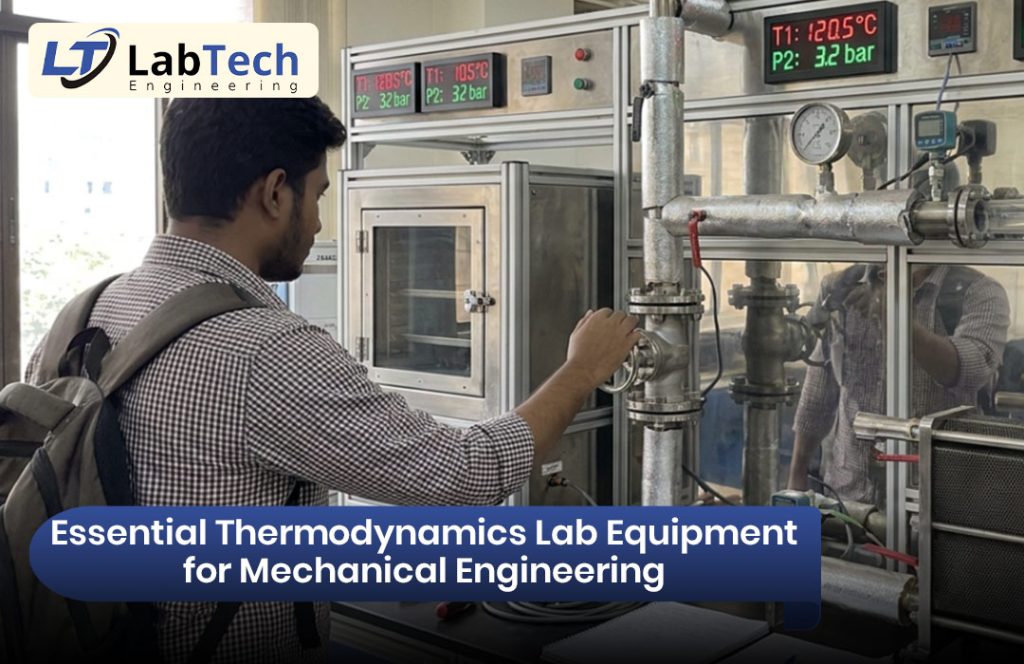
Essential Thermodynamics Lab Equipment for Mechanical Engineering
A mechanical engineering thermodynamics laboratory normally requires different equipment for measuring, testing, and analyzing thermal systems. The following are some of the most important types of Thermodynamics Lab Equipment.
1. Temperature Measurement Equipment
Temperature is one of the most important parameters in thermodynamics. Temperature measurement equipment is used to measure and monitor temperature during experiments.
Common instruments include thermometers, thermocouples, RTDs, digital temperature indicators, and temperature sensors. These instruments can be used in experiments involving heat transfer, boilers, refrigeration systems, and engine testing.
Accurate temperature measurement helps students understand how heat moves through different materials and systems.
2. Pressure Measurement Equipment
Pressure measurement is another essential part of thermodynamics experiments. Pressure gauges, vacuum gauges, pressure sensors, and manometers are commonly used in laboratories.
These instruments help students study pressure changes in systems such as compressors, turbines, boilers, pumps, and refrigeration units. Accurate pressure measurement is important for calculating system performance and understanding thermodynamic processes.
3. Heat Transfer Laboratory Equipment
Heat transfer is closely connected to thermodynamics and mechanical engineering. Heat transfer equipment allows students to study conduction, convection, and radiation.
Common laboratory setups include heat conduction apparatus, heat exchanger test rigs, natural convection units, forced convection units, and radiation experiment equipment.
These systems help students understand how heat moves between surfaces, fluids, and different materials.
4. Heat Exchanger Test Rig
A heat exchanger is used to transfer heat between two fluids without directly mixing them. A heat exchanger test rig is an important piece of Thermodynamics Lab Equipment for mechanical engineering laboratories.
Students can use the setup to study different heat transfer methods and calculate important performance parameters. Experiments may include parallel-flow and counter-flow heat exchange.
This equipment provides practical knowledge that is useful in industries such as power generation, HVAC, manufacturing, and process engineering.
5. Steam Boiler Test Equipment
Boilers are widely used in power plants and industrial applications. Boiler test equipment helps students understand how fuel energy is converted into heat energy and then used to generate steam.
Students can perform experiments to study boiler efficiency, fuel consumption, steam generation, and heat losses. This type of Thermodynamics Lab Equipment is useful for understanding energy conversion and steam power systems.
6. Refrigeration and Air Conditioning Test Rig
Refrigeration and air conditioning systems are important applications of thermodynamics. A refrigeration test rig allows students to study how refrigeration cycles work.
Students can measure parameters such as temperature, pressure, refrigerant flow, and power consumption. They can also calculate the coefficient of performance (COP) and analyze the performance of the refrigeration system.
This equipment is particularly useful for students interested in HVAC, refrigeration, and thermal engineering.
7. Internal Combustion Engine Test Rig
Internal combustion engines convert chemical energy from fuel into mechanical energy. An engine test rig allows students to study engine performance under different operating conditions.
Experiments can cover brake power, fuel consumption, thermal efficiency, mechanical efficiency, and other performance parameters.
Engine test equipment gives mechanical engineering students practical experience with one of the most important applications of thermodynamics.
8. Air Compressor Test Rig
An air compressor test rig is used to study the compression of air and the performance of compressors. Students can measure pressure, temperature, power consumption, and other operating parameters.
This equipment helps explain compression processes and the relationship between pressure, volume, and temperature.
Air compressors are widely used in manufacturing plants, workshops, pneumatic systems, and industrial facilities, making this a valuable laboratory setup.
9. Steam Turbine Test Equipment
Steam turbines are used to convert the energy of steam into mechanical power. A steam turbine test setup allows students to understand the basic operation and performance of turbines.
Students can study parameters such as steam pressure, steam temperature, power output, and efficiency. This type of Thermodynamics Lab Equipment is especially useful for students studying power plant engineering and energy conversion.
10. Flow Measurement Equipment
Accurate flow measurement is important when studying thermal and fluid systems. Flow meters help measure the flow rate of liquids or gases through a system.
Common types include rotameters, orifice meters, venturimeters, and digital flow meters. These instruments are often used with heat exchangers, refrigeration systems, boilers, and other laboratory setups.
How to Choose the Right Thermodynamics Lab Equipment
Choosing the right Thermodynamics Lab Equipment depends on the laboratory’s educational goals, available space, budget, and required experiments.
Before purchasing equipment, consider the following factors:
Experiment Requirements: Select equipment that supports the experiments included in the curriculum.
Accuracy: Measurement instruments should provide reliable and accurate results.
Build Quality: Durable equipment can handle regular use by students and laboratory staff.
Safety Features: Equipment should include appropriate safety controls and protective features.
Ease of Operation: Students should be able to understand and operate the equipment with proper training.
Maintenance: Choose systems that are easy to maintain and have accessible replacement parts.
Technical Support: Supplier support, installation, training, and after-sales service can be valuable for educational laboratories.
Applications of Thermodynamics Lab Equipment
Thermodynamics Lab Equipment is used in many educational and industrial training environments. Universities use these systems to provide practical engineering education, while polytechnic institutes and vocational training centers use them to develop technical skills.
These systems are also useful for research and development. Engineers can use laboratory equipment to test thermal systems, compare performance, evaluate energy efficiency, and understand system behavior under different conditions.
Industries related to power generation, HVAC, automotive engineering, manufacturing, and energy management also rely on thermodynamic principles.
Benefits of a Well-Equipped Thermodynamics Laboratory
A properly designed thermodynamics laboratory provides students with a better learning experience. It allows them to perform experiments safely and understand how theoretical formulas apply to real systems.
A complete laboratory can also improve technical confidence. Instead of only reading about heat engines, refrigeration cycles, heat exchangers, and energy conversion, students can observe these processes through practical experiments.
For institutions, investing in quality Thermodynamics Lab Equipment can improve laboratory facilities and support better engineering education.
Conclusion
Thermodynamics Lab Equipment plays an important role in mechanical engineering education. It helps students understand heat, energy, pressure, temperature, power generation, refrigeration, and other important engineering concepts through practical experiments.
From temperature and pressure measurement instruments to heat exchangers, boilers, refrigeration test rigs, engine test setups, compressors, and turbines, each piece of equipment has a specific purpose. Selecting reliable, accurate, safe, and durable equipment can help educational institutions create an effective thermodynamics laboratory.
A well-equipped laboratory not only supports academic learning but also prepares students for real-world engineering challenges. For universities, polytechnic institutes, and technical training centers, choosing the right thermodynamics equipment is an important step toward developing practical mechanical engineering skills.
Frequently Asked Questions
1. What is Thermodynamics Lab Equipment?
Thermodynamics Lab Equipment includes instruments and experimental systems used to study heat, energy, temperature, pressure, and thermodynamic processes.
2. What equipment is used in a thermodynamics laboratory?
Common equipment includes temperature sensors, pressure gauges, heat exchangers, boiler test rigs, refrigeration test rigs, engine test rigs, compressors, and turbines.
3. Why is thermodynamics equipment important for mechanical engineering?
It helps students connect theoretical concepts with practical experiments and understand how thermal systems work in real-world applications.
4. How do I choose Thermodynamics Lab Equipment?
Consider experiment requirements, measurement accuracy, equipment quality, safety, maintenance, budget, and supplier support.
5. Where is Thermodynamics Lab Equipment used?
It is commonly used in universities, engineering colleges, polytechnic institutes, vocational training centers, research laboratories, and industrial training facilities.