Mechanical engineering combines design, materials, manufacturing, thermodynamics, fluid mechanics, mechanics, and machine systems. To understand these subjects beyond textbooks, students and professionals need practical laboratory experience. Mechanical Engineering Lab Equipment provides the tools and systems required to conduct experiments, test materials, study mechanical behavior, and understand how engineering principles work in real-world applications.
Mechanical engineering laboratories are widely used in universities, engineering colleges, polytechnic institutes, technical training centers, research facilities, and industrial training environments. A well-equipped laboratory allows learners to develop practical skills while gaining a better understanding of mechanical systems and engineering processes.
What Is Mechanical Engineering Lab Equipment?
Mechanical Engineering Lab Equipment refers to machines, testing instruments, experimental setups, tools, and accessories used for practical education and research in mechanical engineering.
Depending on the laboratory’s purpose, the equipment may include material testing machines, thermodynamics trainers, fluid mechanics equipment, heat transfer systems, manufacturing machines, metrology instruments, refrigeration and air conditioning trainers, and mechanical measurement devices.
These systems help students perform controlled experiments, collect data, compare results, and understand the practical behavior of mechanical components and processes.
Importance of Mechanical Engineering Lab Equipment
Mechanical engineering involves many concepts that are difficult to understand through theory alone. Laboratory experiments allow students to observe mechanical systems directly and understand how different parameters affect performance.
Mechanical engineering laboratory equipment helps students:
- Understand mechanical engineering principles
- Perform practical experiments
- Test materials and components
- Measure mechanical properties
- Study heat and energy transfer
- Understand fluid behavior
- Develop measurement and testing skills
- Learn manufacturing processes
- Improve troubleshooting abilities
- Gain industry-relevant practical experience
Practical training also helps students develop confidence when working with machines, tools, measuring instruments, and testing systems.
Types of Mechanical Engineering Lab Equipment
Mechanical engineering laboratories use different equipment depending on the subjects and experiments included in the curriculum.
1. Material Testing Equipment
Material testing is an important part of mechanical engineering. Testing equipment helps students understand how materials behave under different types of loads and stresses.
Common material testing equipment includes:
- Universal Testing Machine (UTM)
- Compression testing machine
- Impact testing machine
- Hardness testing machines
- Torsion testing machine
- Fatigue testing machine
- Spring testing machine
A Universal Testing Machine, for example, can be used to determine tensile and compressive properties of materials. Students can study concepts such as yield strength, ultimate strength, elongation, and material deformation.
2. Thermodynamics Laboratory Equipment
Thermodynamics is a fundamental mechanical engineering subject that deals with heat, energy, temperature, work, and energy conversion.
Thermodynamics laboratory equipment can include:
- Boiler models
- Heat engine trainers
- Steam turbine models
- Gas turbine trainers
- Internal combustion engine test rigs
- Refrigeration trainers
- Air conditioning trainers
These systems allow students to study energy conversion, thermal efficiency, heat transfer, and the performance of different thermal systems.
3. Fluid Mechanics Equipment
Fluid mechanics laboratories help students understand the behavior of liquids and gases under different conditions.
Common fluid mechanics equipment includes:
- Hydraulic bench
- Venturi meter
- Orifice meter
- Bernoulli’s theorem apparatus
- Flow measurement systems
- Pipe friction apparatus
- Centrifugal pump test rigs
- Reciprocating pump trainers
Students can perform experiments to study flow rate, pressure, velocity, head loss, and pump performance.
Practical fluid mechanics training is useful for applications involving water supply, hydraulic systems, pumps, pipelines, and industrial fluid systems.
4. Heat Transfer Laboratory Equipment
Heat transfer is another major area of mechanical engineering. Laboratory equipment helps students understand conduction, convection, and radiation.
Typical equipment includes:
- Heat conduction apparatus
- Pin fin apparatus
- Heat exchanger trainers
- Radiation measurement systems
- Forced convection equipment
- Natural convection apparatus
Students can compare different heat transfer methods and understand how materials, temperature differences, surface areas, and flow conditions influence thermal performance.
5. Metrology and Measurement Equipment
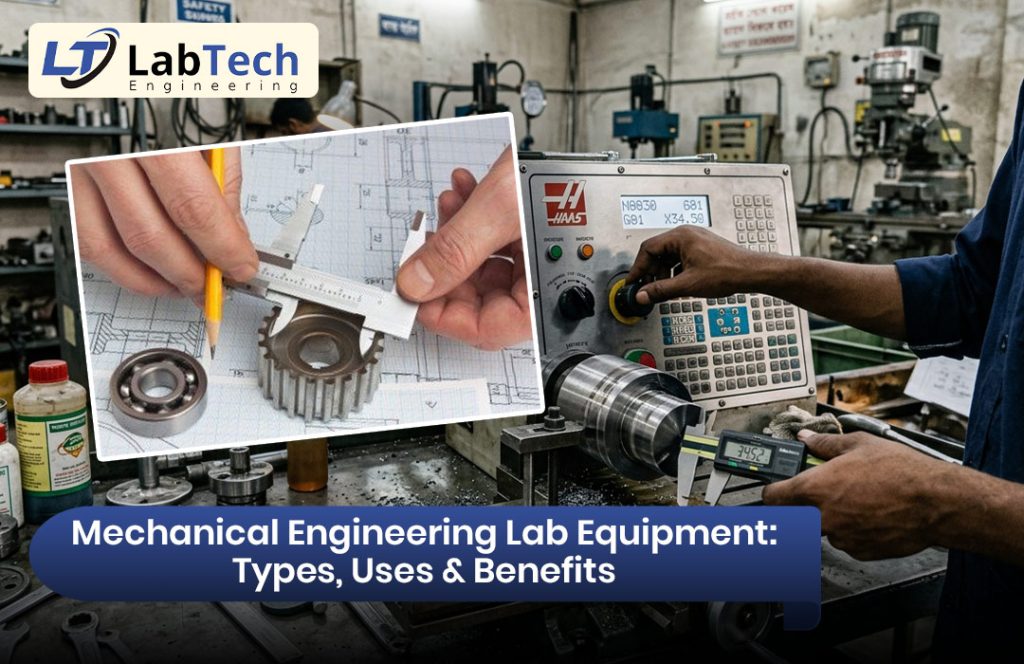
Accurate measurement is essential in mechanical engineering. Metrology equipment helps students understand dimensional measurement, precision, tolerances, and inspection.
Common instruments include:
- Vernier calipers
- Micrometers
- Dial gauges
- Height gauges
- Surface roughness testers
- Profile projectors
- Measuring microscopes
These instruments help students learn how to inspect manufactured components and determine whether their dimensions meet specified requirements.
Manufacturing and Workshop Equipment
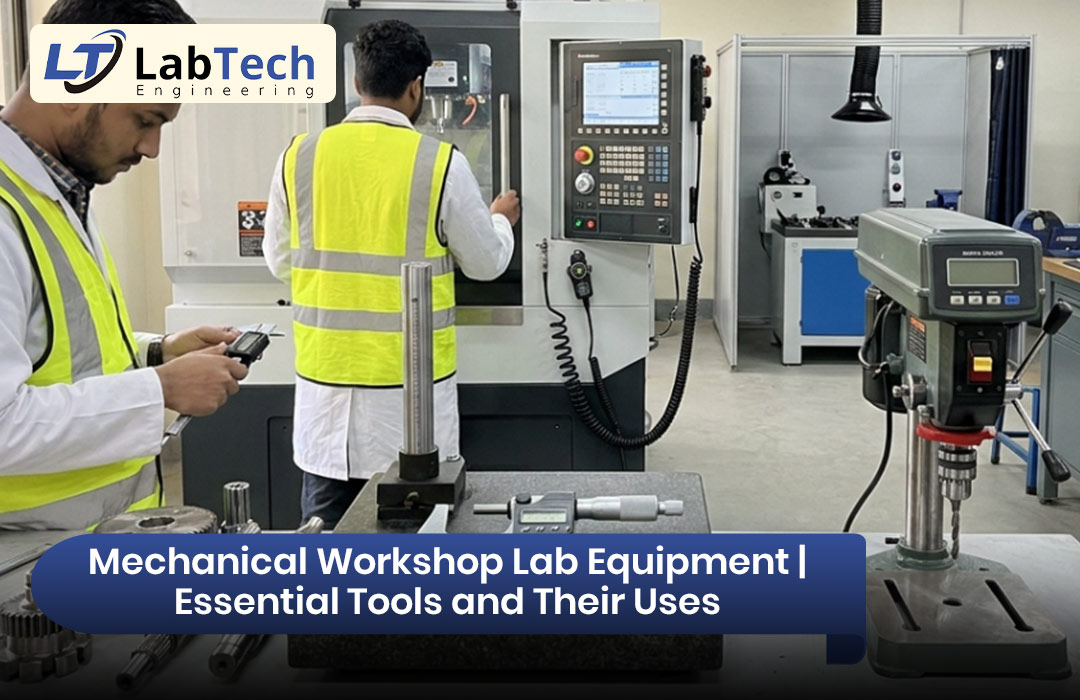
Mechanical engineering education often includes practical manufacturing and workshop training. Manufacturing laboratory equipment allows students to gain hands-on experience with machining and production processes.
Common workshop equipment may include:
- Lathe machines
- Milling machines
- Drilling machines
- Grinding machines
- Welding equipment
- Cutting machines
- CNC machines
Students can learn basic machining operations, cutting techniques, tool selection, dimensional accuracy, and manufacturing processes.
Modern laboratories may also include CNC and computer-integrated manufacturing systems to provide exposure to automated production technologies.
Applications of Mechanical Engineering Lab Equipment
Mechanical Engineering Lab Equipment has applications across education, research, industrial training, and product development.
Engineering Education
Universities and colleges use laboratory equipment to support practical classes in mechanics, materials, thermodynamics, fluid mechanics, manufacturing, and machine design.
Research and Development
Research laboratories use advanced testing equipment to investigate new materials, thermal systems, fluid behavior, manufacturing methods, and mechanical designs.
Industrial Training
Companies and technical institutes can use laboratory equipment to train engineers and technicians in testing, measurement, machine operation, maintenance, and troubleshooting.
Quality Control and Testing
Testing equipment can be used to evaluate materials and components before they are used in manufacturing or construction applications.
Product Development
Engineers can use laboratory testing systems to evaluate prototypes and determine how products perform under different loads, temperatures, pressures, and operating conditions.
Benefits of Modern Mechanical Engineering Lab Equipment
Modern laboratory equipment offers several benefits for students, educators, researchers, and industries.
Better Practical Understanding
Hands-on experiments allow students to see how mechanical principles work in real situations.
Accurate Results
Digital measurement and testing systems can improve the accuracy and reliability of experimental data.
Improved Safety
Modern laboratory systems often include protective covers, emergency stops, overload protection, and other safety features.
Industry-Relevant Skills
Students gain experience with machines and instruments that are similar to those used in manufacturing, testing, and industrial environments.
Efficient Data Collection
Advanced systems can include digital displays, sensors, and computer-based data acquisition, making it easier to record and analyze results.
Better Research Capabilities
Advanced testing systems allow researchers to conduct more detailed experiments and investigate new materials, processes, and technologies.
How to Choose the Right Mechanical Engineering Lab Equipment
Selecting the right equipment depends on the laboratory’s objectives and available resources.
Before purchasing equipment, consider the following factors:
Curriculum requirements: Choose equipment that supports the subjects and experiments included in the academic or training program.
Accuracy: Testing and measurement equipment should provide reliable and repeatable results.
Safety: Machines should include appropriate safety features and protective systems.
Durability: Laboratory equipment should be capable of handling frequent student use.
Ease of operation: Equipment with clear controls and simple interfaces can make practical training more effective.
Laboratory space: Consider the size, weight, and installation requirements of each machine.
Budget: Select equipment that provides the required functionality without unnecessary features.
After-sales support: Technical assistance, spare parts, maintenance, and calibration services can be important for long-term operation.
Maintenance of Mechanical Engineering Lab Equipment
Regular maintenance helps extend the life and reliability of laboratory equipment. Machines should be cleaned regularly, moving parts should be inspected, and components should be lubricated according to manufacturer recommendations.
Measurement instruments should be checked and calibrated periodically to maintain accuracy. Electrical connections, safety switches, cables, and protective systems should also be inspected regularly.
Proper maintenance reduces unexpected equipment failures and helps ensure that students can perform experiments safely and consistently.
Conclusion
Mechanical Engineering Lab Equipment plays an important role in practical engineering education, research, testing, and technical training. From material testing machines and fluid mechanics trainers to thermodynamics equipment, heat transfer systems, metrology tools, and manufacturing machines, each category supports a different area of mechanical engineering.
A well-equipped laboratory helps students understand theoretical concepts, develop practical skills, perform accurate experiments, and become familiar with industry-relevant technologies. When selecting equipment, institutions should consider accuracy, safety, durability, curriculum requirements, laboratory space, budget, and after-sales support.
Investing in reliable Mechanical Engineering Lab Equipment can create a strong practical learning environment and help prepare future engineers and technicians for real-world mechanical engineering challenges.
hort FAQs
1. What is Mechanical Engineering Lab Equipment?
It includes machines, tools, and testing systems used for practical mechanical engineering training.
2. What equipment is used in a mechanical engineering lab?
Common equipment includes UTM machines, fluid mechanics trainers, heat transfer equipment, and metrology tools.
3. Why is mechanical engineering lab equipment important?
It helps students understand engineering concepts through practical experiments and testing.
4. Where is mechanical lab equipment used?
It is used in universities, technical institutes, research labs, and industrial training centers.
5. How do you choose mechanical lab equipment?
Consider accuracy, safety, durability, curriculum needs, budget, and technical support.