Mechanical engineering is a practical field that combines science, design, manufacturing, and problem-solving. Students and engineers need more than textbooks to understand how machines, materials, and mechanical systems work. This is where Mechanical Engineering Lab Equipment plays an important role. These tools and machines help students, teachers, researchers, and engineers perform experiments, test materials, study mechanical systems, and understand engineering concepts through practical work.
A well-equipped mechanical engineering laboratory provides a safe and controlled environment for learning and experimentation. From basic measuring instruments to advanced testing machines, different types of Mechanical Engineering Lab Equipment are used for different purposes.
What Is Mechanical Engineering Lab Equipment?
Mechanical Engineering Lab Equipment refers to the tools, machines, instruments, and testing systems used in mechanical engineering laboratories. This equipment is designed to help users perform practical experiments related to mechanics, thermodynamics, fluid mechanics, manufacturing, materials, and machine design.
For example, students can use a tensile testing machine to understand the strength of a material. A lathe machine can demonstrate machining operations, while a heat transfer apparatus can help students understand how heat moves from one place to another.
In simple words, mechanical engineering lab equipment connects theoretical knowledge with practical experience.
Why Is Mechanical Engineering Lab Equipment Important?
Practical learning is an essential part of mechanical engineering education. Students may understand a theory in class, but laboratory experiments help them see how that theory works in real situations.
Here are some key benefits of using Mechanical Engineering Lab Equipment:
1. Improves Practical Learning
Laboratory equipment allows students to perform experiments instead of only reading about them. This improves their understanding of mechanical engineering concepts.
2. Develops Technical Skills
Students learn how to operate machines, take measurements, record results, and analyze experimental data. These skills can be useful in future engineering jobs.
3. Supports Research and Development
Universities and research organizations use mechanical engineering laboratory equipment to test new materials, machines, designs, and engineering processes.
4. Improves Problem-Solving Skills
Experiments often involve unexpected results or technical challenges. Students learn how to identify problems, analyze data, and find practical solutions.
5. Provides Real-World Experience
Modern laboratories can simulate industrial processes and working conditions. This gives students experience that can prepare them for professional engineering environments.
Types of Mechanical Engineering Lab Equipment
There are many types of Mechanical Engineering Lab Equipment, and each type is designed for a specific purpose. The main categories include:
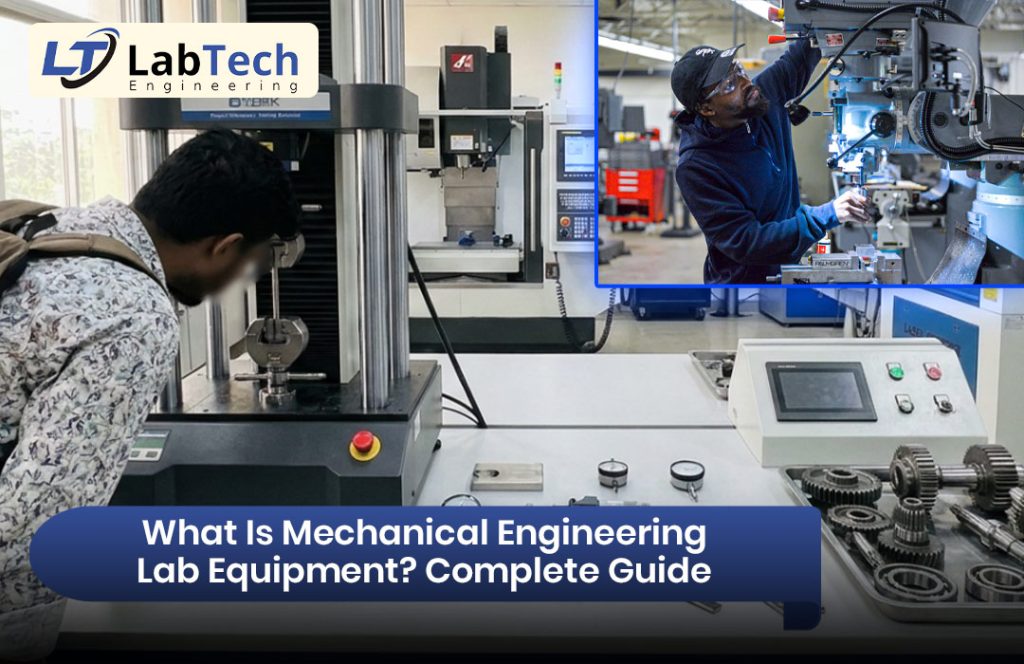
1. Mechanical Testing Equipment
Mechanical testing equipment is used to study the strength and behavior of materials under different forces.
Common equipment includes:
- Universal Testing Machine (UTM)
- Tensile Testing Machine
- Compression Testing Machine
- Impact Testing Machine
- Hardness Testing Machine
- Torsion Testing Machine
- Fatigue Testing Machine
These machines help students and engineers understand properties such as tensile strength, hardness, toughness, compression strength, and fatigue resistance.
2. Thermodynamics Lab Equipment
Thermodynamics focuses on heat, energy, temperature, and their relationship with mechanical systems. Thermodynamics Lab Equipment helps students understand these principles through practical experiments.
Common equipment includes:
- Heat exchanger demonstration units
- Refrigeration test rigs
- Air conditioning test rigs
- Boiler demonstration units
- IC engine test rigs
- Thermal conductivity apparatus
- Heat transfer experiment units
These systems are commonly used in engineering universities and technical training institutions.
3. Fluid Mechanics Lab Equipment
Fluid mechanics laboratories focus on the behavior of liquids and gases. Students can study pressure, flow rate, velocity, viscosity, and other fluid properties.
Typical Mechanical Engineering Lab Equipment for fluid mechanics includes:
- Venturimeter
- Orifice meter
- Bernoulli’s theorem apparatus
- Flow measurement equipment
- Hydraulic bench
- Pipe friction apparatus
- Pumps and turbine test rigs
These experiments help students understand how fluids behave inside pipes, pumps, turbines, and other mechanical systems.
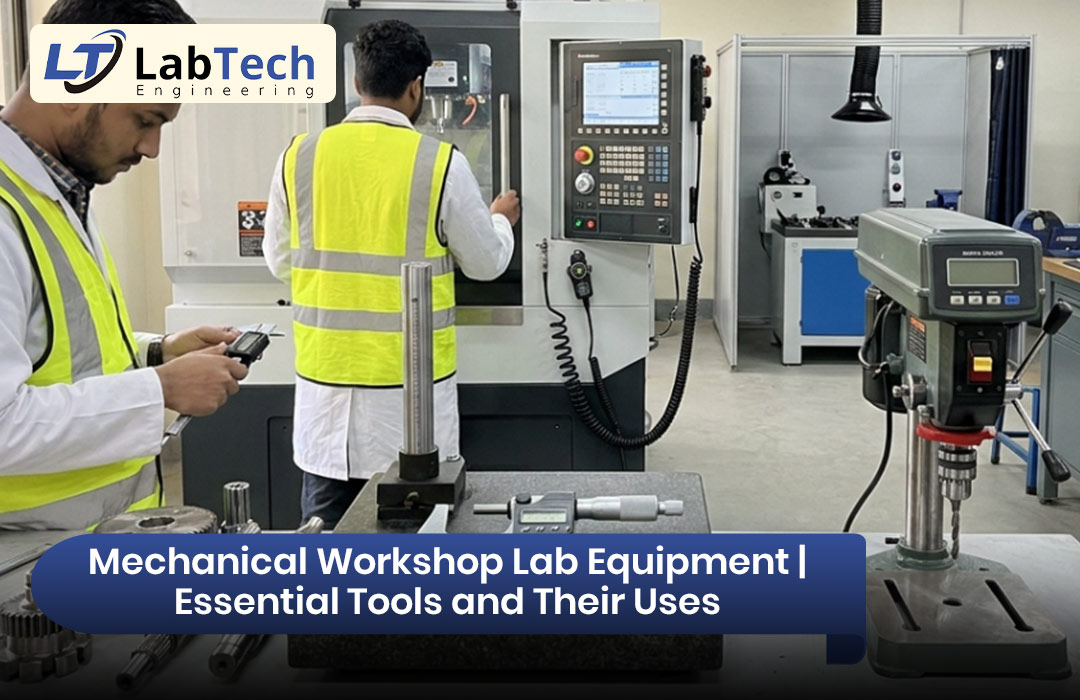
4. Mechanical Workshop Equipment
Mechanical workshops require machines and tools for manufacturing and machining operations.
Common workshop equipment includes:
- Lathe machines
- Milling machines
- Drilling machines
- Shaper machines
- Grinding machines
- Welding equipment
- Cutting tools
- Measuring instruments
Workshop equipment gives students practical knowledge of manufacturing processes and machine operations.
5. Metrology and Measurement Equipment
Accurate measurement is important in mechanical engineering. Metrology equipment is used to measure dimensions, angles, surface conditions, and other physical properties.
Examples include:
- Vernier calipers
- Micrometers
- Dial gauges
- Height gauges
- Bevel protractors
- Surface roughness testers
- Measuring microscopes
Students learn how to take accurate measurements and understand measurement errors.
How to Choose Mechanical Engineering Lab Equipment
Choosing the right Mechanical Engineering Lab Equipment depends on several factors. Educational institutions should first identify the laboratory’s purpose and the experiments students need to perform.
Consider the Laboratory Requirements
Before purchasing equipment, create a list of required experiments and practical courses. This helps avoid buying unnecessary equipment.
Check Quality and Durability
Laboratory equipment should be strong enough for regular student use. Good-quality equipment can provide better reliability and a longer service life.
Look at Accuracy
Testing and measuring equipment must provide accurate and repeatable results. Always check the equipment’s measurement range, accuracy, and specifications.
Consider Safety Features
Safety should be a major priority in mechanical laboratories. Machines should have suitable guards, emergency controls, safety instructions, and other necessary protection features.
Compare Local and Imported Equipment
Institutions may choose between locally manufactured and imported laboratory equipment. Local equipment can offer easier maintenance and faster support, while imported equipment may provide specific advanced features. The best choice depends on the laboratory’s budget and requirements.
Check After-Sales Support
Technical support, spare parts, installation, training, and maintenance are important considerations when purchasing Mechanical Engineering Lab Equipment.
Applications of Mechanical Engineering Lab Equipment
Mechanical Engineering Lab Equipment is used in many educational and industrial environments.
Universities use laboratory equipment for engineering courses, practical classes, student projects, and research. Polytechnic institutes and vocational training centers use it to develop practical technical skills.
Industrial organizations can also use mechanical testing and measurement equipment for quality control, product development, material testing, and research.
Some major application areas include:
- Mechanical engineering education
- Technical education and training
- Material testing
- Manufacturing research
- Product development
- Quality control
- Machine testing
- Research and development
Importance of a Properly Designed Mechanical Engineering Laboratory
Buying individual machines is not enough to create an effective laboratory. Equipment should be arranged according to the laboratory’s workflow and safety requirements.
A properly planned laboratory should have enough space for machines, students, instructors, storage, electrical connections, ventilation, and safety systems. Equipment should also be installed correctly and maintained regularly.
A good laboratory setup allows students to move safely between workstations while giving them enough space to perform experiments.
Maintenance of Mechanical Engineering Lab Equipment
Regular maintenance can improve equipment performance and extend its service life. Laboratory managers should follow the manufacturer’s maintenance recommendations and inspect machines regularly.
Basic maintenance may include cleaning equipment, checking electrical connections, lubricating moving parts, calibrating measuring instruments, and replacing damaged components.
Calibration is especially important for testing and measurement equipment because inaccurate instruments can produce incorrect experimental results.
Final Thoughts
Mechanical Engineering Lab Equipment is an essential part of practical engineering education, research, and industrial testing. It helps students understand engineering theories through real experiments and gives them valuable technical skills.
From mechanical testing machines and thermodynamics equipment to workshop machines and measurement instruments, every piece of laboratory equipment has a specific purpose. Choosing equipment based on quality, accuracy, safety, durability, budget, and after-sales support can help institutions build an effective laboratory.
Whether you are setting up a university laboratory, polytechnic workshop, vocational training center, or industrial testing facility, selecting the right Mechanical Engineering Lab Equipment can create a better learning and testing environment.
Frequently Asked Questions
1. What is Mechanical Engineering Lab Equipment?
Mechanical Engineering Lab Equipment includes machines, tools, instruments, and testing systems used for practical mechanical engineering experiments and training.
2. What equipment is used in a mechanical engineering lab?
Common equipment includes testing machines, lathe machines, thermodynamics apparatus, fluid mechanics equipment, measuring instruments, and workshop machines.
3. Why is mechanical engineering lab equipment important?
It helps students gain practical experience, understand engineering concepts, develop technical skills, and perform experiments.
4. How do I choose mechanical engineering lab equipment?
Consider the laboratory requirements, equipment quality, accuracy, safety features, durability, budget, and after-sales technical support.
5. Who uses mechanical engineering lab equipment?
Universities, engineering colleges, polytechnic institutes, vocational training centers, research organizations, and industries use mechanical engineering lab equipment.