Description
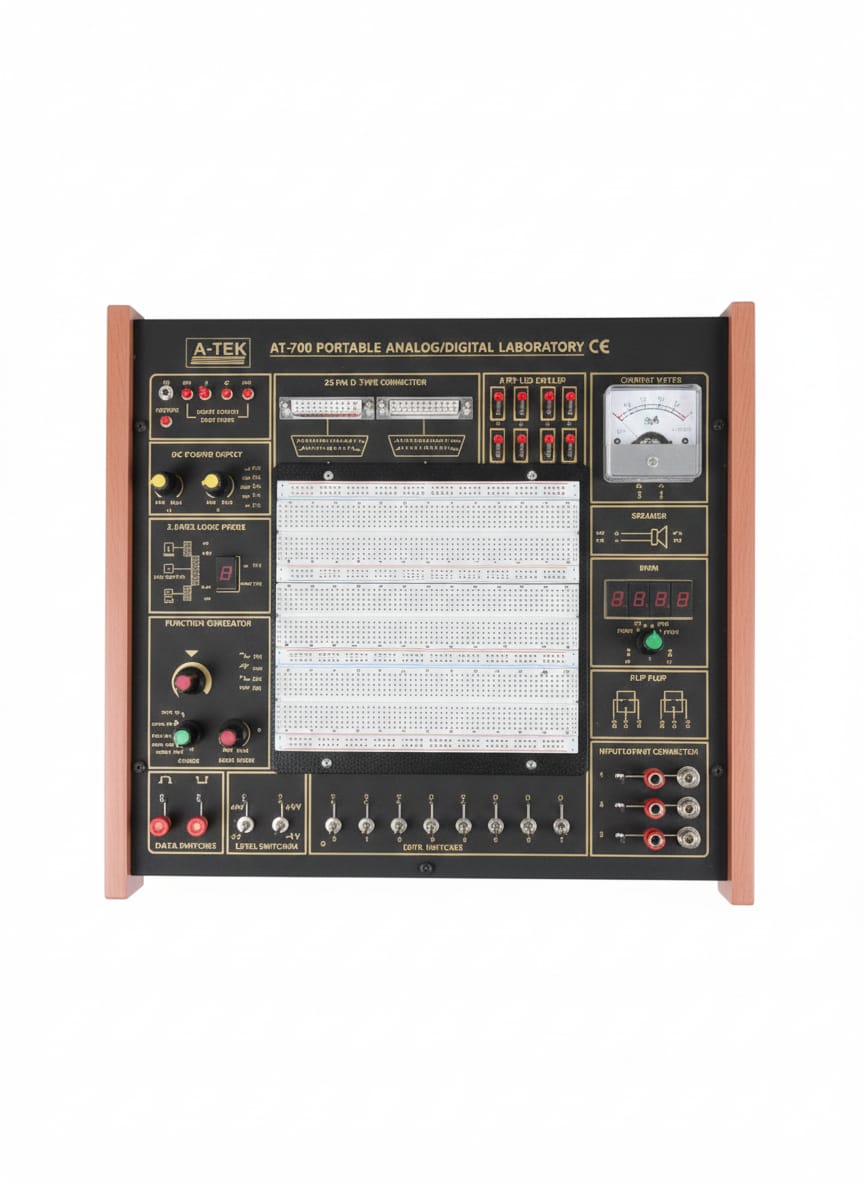
A portable analog/digital trainer board is a comprehensive, self-contained educational tool for circuit design and testing, typically featuring a large solderless breadboard (often >1600-2800+ tie points). Key specifications include fixed (±5Vplus or minus 5 cap V±5)and variable (±15Vplus or minus 15 cap V±15 or 0−30V0 minus 30 cap V 0−30) DC power supplies, a built-in function generator (1Hz−100kHz+1 cap H z minus 100 k cap H z plus1−100+for sine/square/triangle waves), logic input switches, LED indicators, pulse switches, and potentiometers.
Key Technical Specifications
Breadboard: Removable, solderless breadboard with high-capacity tie points (e.g., 2820 tie points) for flexible component placement.
- Power Supplies:
-
- Fixed: +5V/1Apositive 5 cap V / 1 cap A+5/1,-5V/1Anegative 5 cap V / 1 cap A−5/1.
- Variable: Dual000 to±15Vplus or minus 15 cap V±15 or ±30Vplus or minus 30 cap V ±30 DC outputs.
- AC: 9−0−9V 9 minus 0 minus 9 cap V 9−0−9 or 5−0−5V5 minus 0 minus 5 cap V 5−0−5 AC.
-
- Function Generator: 1Hz1 cap H z 1 to 100kHz100 k cap H z 100 or 1MHz1 cap M cap H z 1 frequency range, providing sine, square, and triangle waves.
- Input/Output Components:
-
- Data Switches: 8-bit or more toggle switches for high/low logic.
- Logic Indicators: 8-16 bit LED displays for monitoring output.
- Pulser Switches: Independent, debounced manual pulsers.
- Speaker: 2.5 inch, 8 Ωcap omega Ω 0.25W/1W speaker for audio projects.
- Potentiometers: 1kΩ1 k cap omega 1Ω and 100kΩ100 k cap omega 100Ω variable resistors.
-
- Structure: Housed in a durable ABS plastic or metal cabinet, usually with 2mm brass sockets for connections.